New Report Details Alarming, Relentless Surge of Autism in California

Even limited to more severe forms, autism prevalence in America’s most populous state continues to grow; a 4,300% caseload increase over 35 years

Read the report here.

Read the report here.

San Mateo, California, April 2, 2021 — A new report issued by Autism Society San Francisco Bay Area (SFASA) documents the dramatic, relentless growth of autism cases in the state’s developmental disability services system over the last 30+ years, a trend that continues to today. The report, “Autism in California 2020: A report to the public,” shines a light on an enormous and escalating public health crisis that has dropped from the public eye as the nation has focused on the Covid-19 pandemic.

Based on data from the California Department of Developmental Services (DDS), the surging rates of autism have yet to plateau in the nation’s most populous state, despite widely held assumptions that autism rates would flatten after the unexpected increase in autism rates were first detected in the late 1980s and 1990s. DDS data encompasses cases with significantly disabling autism, and omits milder forms of the disorder. California has long been recognized as keeping the best data on developmental disability-qualifying autism in the country, owing to the requirements of the state’s unique Lanterman Act.

“On this Autism Day 2021, nothing can be more important than reminding the world that the devastating surge of disabling autism, now in its fourth decade, continues unabated,” says SFASA president Denise Haas. “The implications for policy and research are profound.”
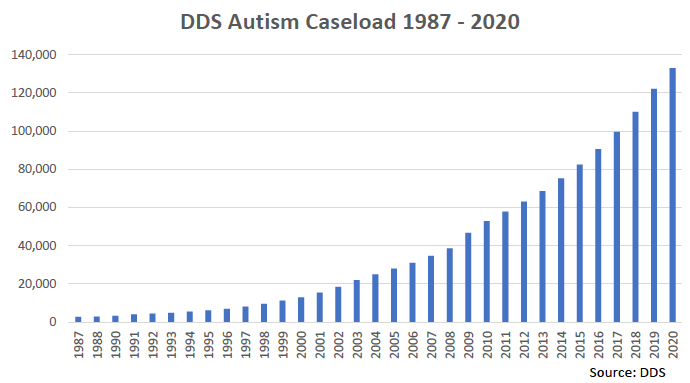
Autism was a rarity in the DDS system through the 1980s, but caseload growth has been relentless since that time. Now the system has about 133,000 autism cases, a phenomenon that has overwhelmed the state’s regional centers, which report that about …

Autism was a rarity in the DDS system through the 1980s, but caseload growth has been relentless since that time. Now the system has about 133,000 autism cases, a phenomenon that has overwhelmed the state’s regional centers, which report that about 70% of all intakes are now autism cases.

Some highlights from the report:

• The DDS autism caseload was about 3,000 in the mid-1980s, but has reached about 133,000 today, reflecting growth of about 4,300%.

• About 10,000 new autism cases, the vast majority of whom are young children, are now added to the DDS caseload each year.

• Birth year prevalence of DDS autism is about 1.5% for children born in 2014, up from .04% for those born in 1980.

• A massive expansion in adult services is needed: for every 40-year-old with DDS autism in 2020, we can expect to see at least 27 40-year-olds with DDS autism in 2054. Much more attention is needed on the critical question of what happens when parents can no longer care for these disabled adults.

The prevalence of DDS autism has increased approximately 11% per year. As of birth year 2014, nearly 1.5% of all children in the state qualified as DDS autism cases (a number that may increase as more cases enter the system).

The prevalence of DDS autism has increased approximately 11% per year. As of birth year 2014, nearly 1.5% of all children in the state qualified as DDS autism cases (a number that may increase as more cases enter the system).

• In the 7 years from 2013 to 2020 DDS added as many autism cases as in the 33 years from 1980 to 2013.

• Consistent with trends in other states and nationwide, autism cases in DDS are about 4:1 male to female.

• The steady rise in children receiving DDS services is evident in all racial/ ethnic groups. Far from plateauing, the trajectories in early childhood appear steeper in recent years. Children of Hispanic (vs. non-Hispanic) mothers were less frequently diagnosed with ASD, but this is changing. 

• The hypothesis that the increase is largely due to greater awareness, changing criteria, and other diagnostic factors has not been substantiated with respect to DDS autism rates: DDS criteria are significantly more stringent than general diagnostic criteria, and grew more stringent in 2003. The forces behind the surge remain largely unknown, but the hypothesis that vaccines are responsible for the increase has been firmly ruled out by numerous scientific studies.

“We are facing a public health crisis of epic proportions,” says Haas. “This unambiguous data carries grave implications — how can we radically expand services and funding to support an unprecedented population of autistic adults who cannot live on their own? Where will they live and who will care for them after their parents no longer can? Current research targets have failed to make serious inroads into understanding causes of the autism increase that has plagued increasing numbers of children over the past 30 years, and we still have no roadmap for the future for the burgeoning population of disabled adults.”

The California report comes on the heels of a presentation on New Jersey autism rates by Dr. Walter Zahorodny, PhD, of Rutgers Medical School, as part of the National Council on Severe Autism Policy Summit. He reported a recent and alarming finding that autism rates in New Jersey were also increasing without a plateau, with recent data indicating autism rates of about 9% in that state’s largest suburban school district. CDC data has already shown that 5% of all 8 year-old boys in New Jersey have autism. Recently published data from other countries has also shown a continuing increase in autism rates, including North Ireland, Japan, and Denmark.

The report is the result of a collaborative effort among advocates and researchers. SFASA wishes to thank the experts who contributed to the Autism in California 2020 report, including Irva Hertz-Picciotto, Ph.D, University of California, UC Davis MIND Institute and Department of Public Health Sciences, UC Davis School of Medicine; Jennie Sotelo-Orozco,Ph.D, Department of Public Health Sciences, UC Davis School of Medicine; Alexander G. MacInnis, M.S., M.S., independent researcher; Elizabeth Angel Guerrero, M.S., University of California, UC Davis MIND Institute and Department of Public Health Sciences, UC Davis School of Medicine; Yunin Ludeña, M.S., M.A., University of California, UC Davis MIND Institute and Department of Public Health Sciences, UC Davis School of Medicine; with assistance from Judy Van de Water, Ph.D, UC Davis MIND Institute; Jessica Cacioppo, M.S., UC Davis MIND Institute and Department of Public Health Sciences, UC Davis School of Medicine; the board of directors, SFASA; and the staff at California DDS who contributed the raw data.

For more information, please contact:
Autism Society San Francisco Bay Area, info@sfautismsociety.org
National Council on Severe Autism: info@ncsautism.org

No, NCSA Is Not “Alt-Right”

Autism wars take ugly turn following inflammatory charge

(Stock photo of a man pointing in an accusatory manner.)

(Stock photo of a man pointing in an accusatory manner.)

By Amy Lutz

I’ve faced many accusations since I began advocating for my severely autistic son Jonah, now 22, and other families like ours. Once my younger kids got old enough to Google me, for example, they wanted to know why I hated autistic people – as they read on one neurodiversity blog. I’ve been called a bad writer, a worse mother, and an ableist. But this is one charge I never in a million years thought I would have to defend myself against.

When a friend on social media recently alerted me to a post that described me as “alt-right,” I assumed there was some mistake. I am both Jewish and a lifelong Democrat – hardly what the Anti-Defamation League was envisioning in its definition of a coalition defined by its rejection of mainstream politics and its embrace of virulent racism, sexism, Islamophobia, and anti-Semitism. 

It wasn’t just me. A little digging revealed that NCSA as a group and President Jill Escher individually had also been branded as “alt-right,” “reactionary,” and “fascist” by neurodiversity proponents, even though such accusations are patently absurd. In point of fact, our board is a mashup of Jews, Christians, Muslims, Democrats and Republicans, and of course not a single alt-righter. What unites us is our shared personal and professional commitment to the severely autistic and their families, a mission that transcends whatever differences we may have.

Moreover, NCSA represents a broad coalition of diverse people from many backgrounds. We draw public support from across the socio-economic and political spectrum –  because that’s exactly what it means to hold mainstream, consensus positions. The issues at the core of NCSA’s advocacy – that severely autistic adults should enjoy the same rights to choose where and with whom they live, work and recreate as the non-disabled; and, if cognitive impairments preclude self-determination, that those decisions should be made by family members, not complete strangers who happen to share the same diagnosis – are not only decidedly not “alt-right,” they strike most people as simple common sense. Just consider the impressively diverse list of signers on this open letter to The New York Times from August 2020, which called the paper to task for excluding those with significant intellectual and developmental disabilities from their coverage of the 30th anniversary of the Americans with Disabilities Act.

Over 70 autistic adults, family members, researchers, clinicians and providers representing the entire ideological gamut – including writers from the proudly lefty Huffington Post to the staunchly conservative National Review – added their names (and we could have included thousands more, but opted not to for obvious logistical reasons). In our extraordinarily polarized political climate, is there anything else that has enjoyed that level of bipartisan support? 

Is this the moment neurodiversity proponents “jumped the shark” – when they abandoned any pretense of engaging with NCSA’s actual positions and resorted instead to trying to discredit us with hysterical mudslinging? This is a classic example, in other words, of what is called the “ad-hominem fallacy,” attacking the person instead of the argument, usually because the argument itself is too strong. Which means, I suppose, that I should just explain to my kids that these bizarre insults are really just back-handed compliments that confirm the strength of our positions. Still, I admit my sensibilities were strangely offended at such sloppy character assassination: couldn’t they have made even the slightest effort to come up with a more convincing epithet than “alt-right”? 

Amy Lutz is Vice President of National Council on Severe Autism.


Disclaimer: Blogposts on the NCSA blog represent the opinions of the individual authors and not necessarily the views or positions of the NCSA or its board of directors.

“I tried to take my life last August”

The mother of an adult son with severe autism shares her heartbreak: “There is no end to the torture this world has in store for him”

Matthew then and now. No china in our china hut—severe autism parents might relate!

Matthew then and now. No china in our china hut—severe autism parents might relate!

By Sharon Fair

My son Matthew was born in a toilet at a Denny’s outside of Sacramento. His birth mother went to prison after injecting him, as an infant, with heroin. Of the many cards stacked against him, Matthew also has severe autism.

Raising a son who literally would not sleep and not stop moving, climbing, jumping, running was not exactly easy (you can see a old TV news story about us here), but now that he’s an adult we’ve seen a new host of problems. Mainly that the systems set up to serve the disabled and the mentally ill are not equipped to handle our kids.

Out of desperation I recently took Matthew to a psych hospital a few weeks ago. One week in they drugged him so heavily he slept for 25 hours "and the nurses were loving it!"

I found out that during that week, the staff had performed five "takedowns" on my son and that eight injections were given. His cheekbone was also fractured, probably related to an encounter with the sheriffs. I took Matthew out of the psych hospital only to be berated by my state worker for doing so.

Matthew's brain function dwindles and his aggression increases with every assault on his brain. Every time he's thrown to the ground and injected with more of the drugs that hurt him, he trusts less, he functions less.

Every assault in the last year was by someone he should've been able to trust. Group homes, ADH caregivers, social workers, a DDD worker, APS workers, doctors, nurses, police, deputies and every person who should've stepped up for him, that didn't.

And who takes the brunt of his frustration at all this injustice? The person who won't walk away, and he knows it.

I read recently about a mom in Connecticut who drove into a river and drowned herself and her special needs adult son.

The news story said she was such an amazing woman, always on campus, and her son was loved by everyone. It doesn't say that she was always on campus because she probably couldn't get the services he needed, so she did them herself. It doesn't say that her son probably had no friends after high school.

It doesn't tell our story.

I'll be honest and tell you I tried to take my life last August when I thought I'd lost Matthew to the system that was killing him. I felt I had no one on my side. No one understood my love for him.

I'd be lying if I said I haven't thought of taking both of our lives to spare him more of the indignities he's experienced. There is no end to the torture this world has in store for him.

Thankfully, I woke up and realized that we're here for a reason and we have to finish this journey, no matter how unpleasant. Thankfully, I also found others who have it worse than us. Other parents here have journeys that I can't even fathom!

I can be a support instead of a whiner. I can do that.

I feel for that mom who felt she had no other options than to die that day. I even understand her. I wish her peace and hope she and her son are together without limitations. I wish her real story was told.

Matthew is in the hospital again. I asked the doctor what I should do when he tries to kill me and he said, "take him to the hospital.” But I took him to a different hospital in hopes of getting him transferred to a hospital in Phoenix that has an Autism unit. So far insurance is denying it.

My other son, Ricky, who died, would be 40 on Monday and I'm completely depressed. This, too, will pass. Right?

Sharon Fair is the mother of an adopted son with severe autism. They live in Arizona.

Disclaimer: Blogposts on the NCSA blog represent the opinions of the individual authors and not necessarily the views or positions of the NCSA or its board of directors.

A break in routine breaks my autistic son

A prose poem about structure, predictability, and the blessings of school, by a single dad of a son with severe autism

 
jason.jpg
 

By Jason McCarver 

My son is 12, severely autistic, epileptic, ADHD, with learning disabilities. 
He’s attended school since he was 3 years old, started with a Headstart preschool
A week after his 3rd birthday. In all those years he’s missed school maybe 5 
Times due to being sick. The only other time he misses school are holidays.

Routine for my son is extremely important, it keeps him calm. Without routine 
My son regresses to almost a toddler and starts having meltdowns involving 
Self harm. He punches, scratches, smacks himself. Screams and hollers at the 
Top of his voice, which lasts for hours and hours sometimes.

The routine of school is very important for my son, without it, it’s almost impossible 
To get him to remain calm and focus on other things. Every time there’s a holiday,
I have to prep him for it, starting a month ahead of time. Even with extreme prepping 
Daily reminders etc, he still freaks out when the holiday arrives and school is closed.

Preparing him for any type of change in his routine is pointless, once his routine is set in place 
He expects it to happen no matter what. There’s no bargaining or really any skill that helps.
I basically have to detox him from the routine, if it’s only for a day, I just ride out the meltdowns.
If it’s for an extended period of time, I have to detox him from everything associated with the routine, and establish a new one. 
It sounds extreme I know, but it’s absolutely necessary in order for him to function.

This leads to confusion and conflict, and after he’s finally settled into a new routine, it has to end
And the old one starts back up, and hell no it’s not an easy transition back. 
The transition back usually consists of meltdowns involving self-harm. It’s truly an never-ending cycle of hell my son goes through.
It’s also the main reason I tell whoever is working with my son, only introduce things to him you’re prepared to do pretty much daily. Once he gets attached, it becomes part of his routine and nothing is going to make him break his routine without resistance.

Our daily home life is also built on routine, very structured doing the same thing every damn day 
All the damn time. 
The older my son gets, the bigger he gets, the stronger he gets, and the worse his meltdowns get.
His school is very much aware of his his meltdowns and how bad they get.
His whole entire school day is built around his needs, his routine is structured so he can easily do it everyday.
Only if school was open 365 all year long, that would be like heaven.

Jason McCarver battles nonsense in the Twitterverse with nuggets of personal wisdom. Follow him on Twitter @jayhood73.

Autism is a living hell for my son. I'm supposed to celebrate that?

“Ben cannot speak, is in diapers, doesn’t sleep, cannot sit still, hits himself every single day, puts his head through walls and windows, needs us to brush his teeth, bathe him.”

snow.jpg

By L.A.

I recently saw an article on the new movie, Music, where the uninformed author wrote that the worst part of the entire movie is that it leads us to believe autism is a struggle.

This recent incident got me as it is one of the biggest issues I have with autism...

I then mentioned to someone that I had a son who is severely affected by autism and the response was, “Me too. It’s tough but I wouldn’t change a thing.”

Now, years ago I would have sheepishly agreed.

For some strange reason we parents have to celebrate this struggle our children go through because God forbid someone get the wrong idea and assume we hate our child.

This is such a strange phenomenon that has happened over the years with severe autism, thanks to the nightmare that is the spectrum.

I have never had to explain to anyone ever that I still love my husband while describing the struggles that come along with his type 1 diabetes.

It truly baffles me.

Yet, I am expected to celebrate my son’s biggest struggles. To hide the hell he goes through. If you don’t understand, then you don’t know this level of autism and that’s ok. I’m here to explain.

See, I’d give anything to help Ben while autism is doing the very opposite. Autism is a neurological disorder and it affects everyone differently. Ben is deeply affected.

Ben is a person. A beautiful person with an amazingly sweet and kind soul. A few “cool quirks” that autism might bring isn’t collateral for what he has to struggle through 24/7. That is key to understanding this end of the spectrum.

No parent should ever feel bullied into suggesting their child’s suffering is a gift. Ever.

Ben cannot speak, is in diapers, doesn’t sleep, cannot sit still, hits himself every single day, puts his head through walls and windows, needs us to brush his teeth, bathe him. You name it... he needs our assistance. You get my drift. Nothing is simple for him.

We can’t take him out in public any longer (especially now with the pandemic), he’s stronger than most grown men. He needs sedation for the simplest things and is on an unbelievably strong cocktail of meds to keep him from beating himself to death.

You will never ever find me parading Ben around in autism gear... EVER! That is not Ben. (Another BIG pet peeve of mine but to each their own).

Ben is Ben. Ben deserves so much and it bewilders me that I’m supposed to scream to you all that it’s a gift what he has to struggle through.

That’s not ok.

To me that is only meant to show you how wonderful I am as a mother in some sick twisted way. Look at me loving him regardless. (Yuck!)

Now, in my World... this is my dearest son who I’d do anything for. As far as I’m concerned no parent should have to explain that.

I don’t think he would choose his Mom to be around him 24/7 caring for him in every way at age 16. I think he’d like to be doing what most 16 year olds are doing. I would also bet he’d love to speak/communicate to tell us the simplest things we all take for granted, such as “my stomach hurts” or “I feel sad today”. Instead he puts his head through our walls to express his frustration and pain.

Shame on anyone that can’t see that is struggling with autism!!

My son deserves the same as everyone else and I will do everything to see that through.

He is my greatest gift and autism has no place in that sentence and I think he’d be angry at me if I attempted to portray it any other way.

Autism is a spectrum... it is not the same for everyone. That is key. The different perspective deserves to be heard and absolutely respected!!

I got you Ben. I see what you do daily and I hear you. No words needed. I see your struggle and I know how hard you fight.

No parent should ever feel bullied into suggesting their child’s suffering is a gift. Ever.

Nor should any stranger suggest autism isn’t a struggle for some. That is absolutely something only someone who is uneducated would suggest.

If you feel it’s a fun quirky gift... that’s your choice and I respect that but not this Momma. Not in the World we are living in. As far as I’m concerned this side deserves respect too.

Nor does me speaking out mean in anyway that I dislike my child. Quite the contrary.

L.A. is the pseudonym of a mother of son with severe autism. They live in Minnesota.


Disclaimer
: Blogposts on the NCSA blog represent the opinions of the individual authors and not necessarily the views or positions of the NCSA or its board of directors.

The Cognitive Distortions that Feed Neurodiversity Radicalism

A young woman on the spectrum sheds light on some forces behind anti-parent cyberbullying.

A series of cognitive distortions leads to the excesses of neurodiversity radicalism, including parent shaming, writes the author. [Stock photo of funhouse mirrors]

A series of cognitive distortions leads to the excesses of neurodiversity radicalism, including parent shaming, writes the author. [Stock photo of funhouse mirrors]

By Lucy Kross Wallace

A year ago I was en route to becoming the type of "neurodiversity activist" who cyberbullies autism parents in the name of tolerance. 

I had every hallmark of such an activist: a recent ASD diagnosis, a desire to partake in the social justice that surrounded me, irrational self-confidence, ignorance of the more severe end of the autism spectrum, and a Tumblr account. 

Clearly, if I’m writing this blog post, a lot has changed since then. While I don’t wish to excuse my former self or the behavior of anyone who harasses parents or trivializes autism, I do want to elucidate a series of cognitive distortions that accelerate radicalization. Eventually, these distortions can motivate extreme behavior, including harassing autism parents online, calling them “MaRtYr MoMmIeS,” and accusing them of wanting to murder their children. Disturbing as these actions are, my experience as a former ideologue shows that there’s a way out of this rabbit hole.

Autism as an Identity

The path toward neurodiversity radicalism begins with the adoption of autism as an identity and the perception that being autistic grants a person authority on all autism-related matters. My slide into this mindset started innocently enough. After years of mental illness and unsuccessful treatment, I finally had a diagnosis that explained my impairments and idiosyncrasies, enabling my doctors to help me transition from psych ward patient to college student. Reading about autism online gave me a vocabulary to describe my experiences and reassurance that I was "different, not less."

But of course, in classic Asperger’s fashion, I took this useful framework to an unhealthy extreme. "Autism is a part of who I am" became "autism is a critical part of who I am," which then became "autism is who I am." I was inspired in particular by the Autistic Self Advocacy Network, whose slogan – "nothing about us without us" – invoked a sense of urgency, suggesting that any failure to insert oneself aggressively into conversations about autism constituted a betrayal of the cause. The motto "autistic people are the real autism experts" appealed to me for the same reason. It offered automatic street cred that I could use however I wanted. Who wouldn’t want to be more knowledgeable than a doctor or parents pouring themselves into care for autistic children simply by virtue of having a certain diagnosis?

Identitarianism Fosters a False Equivalence

Next, due to the concept-creep associated with the word "autism" and the collapse of multiple diagnoses into one autism spectrum category, we suffer an illusion that different people with “autism” have more in common than they actually do. In my dark days of advocacy, I fought fiercely against the notion that my autism was any less severe than anyone else’s, drawing on bizarre, nonsensical analogies I’d found online that equated autism to cupcake flavors and insisted that a single person can be both high- and low-functioning. Of course, these arguments were ridiculous, but admitting that my autism was relatively mild would have forced me to surrender my sense of authority.

Normalization of dysfunction

The radicalization is accelerated by advocates’ stringent adherence to the neurodiversity tenet that autism is "natural" and "normal." This argument constitutes a logical fallacy and immediately crumples upon close examination, as autism is no more natural than earthquakes, syphilis, wildfires, or dementia. Moreover, the research literature strongly suggests that autism has abnormal physiological roots beginning early in brain development.

The “natural” argument is much easier to make for those with milder autism, where it may indeed be the case that stigma overshadows intrinsic impairments. For instance, there is substantial evidence to suggest that when high-functioning autistic girls "camouflage" and attempt to fit in with their peers, they run the risk of developing mental illness. This predicament highlights the importance of acceptance, rather than attempting to "fix" autism, for some people on the spectrum. It would be erroneous to overgeneralize this conclusion, but this is precisely what neurodiversity advocates do.

The fallacy of mutual exclusion

While there may be no one exemplar for neurological health, some people are clearly impaired. We can respect and love people with disabilities while hoping to remedy their impairments whenever possible. And we can fight discrimination without downplaying the value of prevention and medical intervention. Both concepts can and should exist simultaneously; they are not mutually exclusive.

Negative filtering

On Tumblr, my fellow activists and I complained endlessly about instances of "ableism," neglecting the enormous strides our society has made in accessibility and inclusion over recent decades. Negative filtering is also evident when neurodiversity advocates scorn "autism warrior parents" whose experiences are dismissed the moment they question neurodiversity doctrine.

There is also routine discounting of the positives (e.g., the parent’s love for their child), and routine catastrophizing, for example, claiming that a negative comment about autism will somehow result in a parent (no matter how devoted and loving) wishing to abuse or even murder their child. When the activist goes on to harass the parent, she genuinely believes that she is speaking out against an enormous injustice and that "silence is compliance."

Black-and-white thinking

Neurodiversity devotees tend to favor dichotomous thinking over nuance. On multiple occasions, I began reading articles on autism, only to shudder the moment I noticed a phrase like "affected by autism" or "living with autism." I had internalized the neurodiversity preoccupation with language so thoroughly that these innocent words were enough to make me discard an entire article, deciding that its contents were irredeemably bigoted. These rigid judgments fed into my belief that the world was composed of good people and ableists, matching the “you’re either with us or against us” attitude that characterizes the neurodiversity movement.

Personalization

I immediately connected conversations about autism to my own experience, never missing a chance to pipe in with my (often uninformed) opinion. This distortion plays a significant role in the harassment of autism parents: thanks to the neurodiversity movement’s obsession with language, a parent’s use of perfectly reasonable terms like “suffering from autism” or “severely autistic” are taken as personal insults, met with a self-referential chorus of “what about me?” Advocates concern themselves only with their own identities and needs, rejecting realities of severe autism that could sully their preferred portrait of the disorder. In other words, they see themselves as victims of phrases that were never meant to apply to them.

Out the Other Side

Ultimately, I was driven away from neurodiversity not by its positions but by its attitude/actions toward detractors. As I explored various criticisms of neurodiversity, I was struck by advocates’ refusal to acknowledge these concerns and by the vitriol hurled at critics.

The turning point came when I read two scathing responses to Jonathan Mitchell’s eminently reasonable criticism of the neurodiversity movement. The author of the first response mocks Mitchell’s struggles to navigate dating ("Perhaps if he’d stop making sexist remarks and would stop talking…about smearing feces, he’d have better luck with women") and intimates that Mitchell is responsible for his own unhappiness ("He is focused on something that will never happen [i.e., an autism cure]"). The second response, by a writer using the ironic pseudonym "Humble Aspie," begins with a clumsily photoshopped parody of a 1936 Nazi propaganda poster. Aspire to being a pure bred aryan [sic] winner? the caption reads. Join Self Loathing Autistic People #autisticdarkweb. Needless to say, this appalling attempt at satire trivializes the atrocities of the Holocaust and confirms Mitchell’s observation that neurodiversity proponents "are frequently less than cordial to those who disagree with them" – to put it mildly.

I didn’t end up reading the rest of "Humble Aspie’s" article. Instead, I slammed my laptop shut and decided that my neurodiversity days were over. If your version of justice involves cyberbullying and slander, count me out.

The Way Forward

While certain advocates have demonstrated cruel and egregious animosity toward neurodiversity dissidents, I suspect that most #ActuallyAutistic internet users would never be so vicious toward victims in real life. Social media distances us from one another, allowing us to see others as avatars for ideology rather than human beings. Much of the support for the hatred of "autism warrior parents" is tacit: casually liking a Tumblr post or a tweet, reblogging the occasional sarcastic meme, passively buying into stereotyped depictions of "curebie moms." These decisions’ apparent smallness belies their cumulative effect, making it easy for internet users to worsen the problem of bullying without grasping the consequences of their actions.

Meanwhile, those who genuinely oppose the neurodiversity doctrine may be reluctant to speak out for fear of being harassed and abused. There is no alternative to neurodiversity that offers the same instant friends, prepackaged identity, expert branding, trending hashtags, catchy slogans, appealing merchandise, and support from popular media outlets. This renders opposition to the movement virtually invisible, discouraging open criticism.

I see three crucial components of working toward change. First, we need condemnation of this bullying on a much broader scale. Leading advocacy organizations and responsible clinicians, providers, and researchers must take a firmer stance against anti-parent bullying. Explicitly stating that harassment is unacceptable should be a no-brainer.

Second, activists should engage in self-reflection and demonstrate the same awareness that they demand from others. My propensity for rigid thinking and hyperfixation contributed to my neurodiversity obsession. Once I recognized this and challenged my rigid thought patterns, I developed a much more balanced mindset, gained empathy for families and individuals affected by severe autism, and stopped wasting time on pointless quarrels about language.

Finally, I think that much of neurodiversity radicalism lies in fear – fear of stigma, fear of discrimination, and fear of being overlooked. I didn’t get the help I needed for years because doctors assumed that because my autism was mild, I should be able to manage on my own. It wasn’t until I became severely ill that anyone paid serious attention to my diagnosis. But as the National Council on Severe Autism has stated in its FAQs, the reality of low-functioning autism doesn’t mean that high-functioning autistics don’t deserve support or don’t have a real disability. This is not a competition, and when we treat it like one, everybody loses.

Lucy Kross Wallace is an undergraduate student at Stanford University.

Disclaimer: Blogposts on the NCSA blog represent the opinions of the individual authors and not necessarily the views or positions of the NCSA or its board of directors.

My Sons with Autism Are Isolated and Traumatized — and Pennsylvania Wants It That Way

“They are living a life of hell without purpose or choice.”

Recent photo of holes in the walls of the twins’ Pennsylvania group home.

Recent photo of holes in the walls of the twins’ Pennsylvania group home.

By Jody Weaver 

Our sons Matt and Dan are 27 year-old identical twins with severe forms of autism. They have lived together in a residential group home for the past five years, with each year becoming worse.

They have experienced increased anxiety, aggression, self-injurious behaviors, weight gain, depression, rages, increased medication use and overall poor health. They have endured living in the community in a cul-de-sac with neighbors who resent their presence. Countless police calls and ambulance rides to the ER. Both Matt and Dan have become isolated and traumatized. In general, they are living a life of hell without purpose or choice.

But it wasn’t always this way.

Before they aged out of school, they were safe, confident and happy in a Camphill residential farmstead-based learning program. They lived and worked with peers and coworkers growing organic food, caring for animals, learning trades and living an authentic purposeful life. There was no feeling of isolation and fear and often immersed in nature, which met their acute sensory needs. They had room to explore and be themselves and enjoy what nature had to offer.

But this all ended at the age of 21. 

They “fell off the cliff” and into Pennsylvania’s nightmarish adult system. Our state has one of the most restrictive interpretations of the Medicaid HCBS Setting Rule. This means that instead of having a choice that meets their need for structure, purpose and outdoor space, a small group home setting became the only option.

This has meant churning through several different homes, endless hours trapped in houses watching TV or lying in bed, poor food choices, hours of van rides or maybe a walk in a mall or around a neighborhood. They have hated it since day one and their behaviors have shown it.

They have demolished several houses multiple times. They have destroyed rooms of furniture, kicked countless holes in walls, pulled cabinets off walls and flushed so many items down the toilet that the plumbing backed up and flooded the house. The worst part of these increased behaviors is that they have physically injured and hurt staff. Staff have sustained many hits and blows to various parts of their bodies, bite wounds requiring up to 20+ stitches, broken arms and noses, fractures, ripped clothing and broken glasses, and worst of all, one sustaining a mild brain injury. 

These aggressive behaviors reflect just how frustrated, depressed and unhappy they are in their current situation. How do I know this you ask? Because our home has NEVER encountered any destruction or holes in walls by either of them. No items have been broken, ripped or destroyed. The four of us go out shopping together and eat in restaurants without any issues. Occasional behaviors are addressed and redirected and we persevere as was the case during their time in the Camphill environments. 

Now their behaviors are interpreted as their fault and they are sent to be locked up in a hospital room by the very system that is supposed to serve and protect them!

But what are the alternatives? We are unable to care for them at home, and Pennsylvania has erected nothing but roadblocks to other options. As hard as we have tried to find or create a program suitable for our sons, Pennsylvania’s answer is always “no.”

Per congressional mandate, Medicaid Home and Community Based Service (HCBS) dollars are supposed to pay for services to support severely disabled adults like Matt and Dan. There is nothing in the legislation or regulations that restricts those options to “small group homes.”

Pennsylvania’s implementation is so restrictive that it will not allow HCBS recipients to live and work at the same address. It will not allow congregate settings, even for those who benefit most from an open and roomy setting with peers. Also, it arbitrarily prohibits rural settings. They call them “isolating” when in reality, our sons have never been so isolated as they are now in this group home.

Now, our sons’ terrible situation has become even worse.

In October 2020, Matt and Dan transitioned from one group home to another with a new agency. Within the first 13 days, 911 was called 17 times due to a crisis situation with Dan. Each time, Dan was severely head banging on walls, furniture, door frames, tables and headbutting staff. He was engaged in aggressive behaviors, excessive property damage and was considered a safety risk to himself and staff. He was taken to the Hershey Medical Center Emergency Department and locked up in a Psych holding room under observation. He was held under a 302 for a total of 13 days waiting for an inpatient hospital placement. 

We were told by hospital staff that he went unattended because he had aggressive behaviors: when we visited he was not bathed, not shaved, hair not washed, teeth not brushed. Vomit matted his hair and he was often severely dehydrated. We bathed and cleaned him up at each visit and brought him food and plenty to drink. Finally, after three weeks, we could no longer watch him deteriorate in that locked empty cinderblock room! We took him home with us and declined any further inpatient waiting list. 

During Dans’ time home with us, his entire case management team (parents, agency, ODP, county, licensing, etc) has been meeting every Friday via Zoom to discuss the situation. After two and a half months, the team decided it would be good to slowly begin to transition Dan back to the group home. 

Around this same time, Matt also had aggressive behaviors and ended up in the same Psych room at Hershey on two different occasions for several days. He too exhibited dangerous explosive behaviors with excessive property damage and aggression towards staff. Matt was able to transition back to the group home after both incidents, but is having difficulty managing his anxiety. 

Last week Dan returned to the group home for a brief three-hour visit with his brother and to have dinner together. Within one hour of dropping him off, he became so violent against himself and staff that four police cars were called to the scene. An ambulance arrived and strapped him in a gurney and once again transported him back to the same locked room at Hershey.

We arrived at the group home just as the police and the ambulance were arriving. What transpired was a nightmare. There was a tug-of-war between a staff person and Dan with a large crock pot that had been cooking a roast for about six hours, filled with hot liquid. There were many frozen bags of vegetables taken from the freezer and beaten against the cabinets strewn across the kitchen floor. Many broken hard plastic dinner plates smashed throughout the dining area. Multiple holes in the walls throughout the house. Staff was assaulted repeatedly, while trying to use pads to intervene. 

Dan yelled “No, no, no” and “Mommy, Mommy, Mommy” as they loaded him into the ambulance. 

On the following call, Dan’s team recognized it was not safe for him to return to the group home nor our home given his recent behaviors. The group home provider went over Dan’s history of violent behavior and said they were afraid he would eventually seriously hurt himself or someone else if he returned to the group home. The provider even asked the question if they would be held liable if Dan seriously harmed himself. The question was asked in which setting would he be most appropriate and the provider answered, “a farmstead or lifesharing community.”

Ashley Kim Weiss, national coordinator for the nonprofit group Together for Choice, pointed out that CMS’s HCBS Settings rule does not prohibit disability specific settings and Dan is regressing and endangering himself and others because Pennsylvania is forcing Dan to be in a setting that does not meet his needs.

Some people on the call tried saying that the federal rule prohibited disability-specific settings, but Weiss shot back that this was untrue. She feels at some point someone should be held liable for all the human trauma caused by PA’s misinterpretation of the Settings Rule.

Pennsylvania’s extreme and unfounded interpretation of the Settings Rules is a mockery of the “person-centered planning” process that the HCBS Rules require. Now, one or possibly both of them face being institutionalized. How is this not a violation of their civil rights? Pennsylvania is actively harming the same group of people it’s supposed to serve and protect using our tax dollars via Medicaid.

We desperately need to expand options for community living that meets the actual needs and choices of those with severe autism. 

Jody Weaver is the mother of two sons with severe forms of autism. She lives in Pennsylvania.