Prevalence of autism up in schools across the U.K.
Rate more than doubles in Northern Ireland, Scotland, England and Wales
By Jill Escher
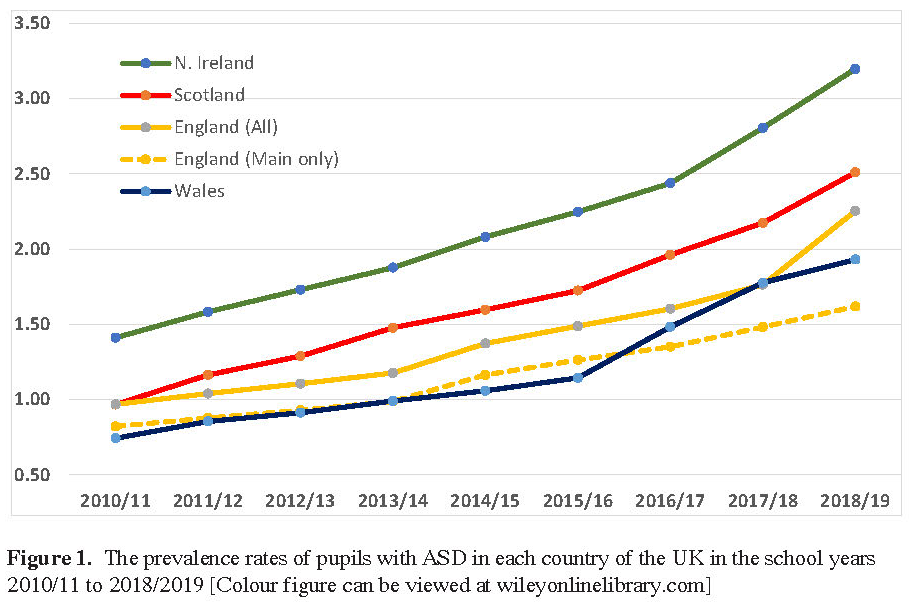
A new report on autism in U.K. schools indicates sharp increases in prevalence rates over a nine-year period through 2019. The report saw autism rates climbing in all four countries of England, Wales, Scotland and Northern Ireland.
Northern Ireland had the highest prevalence throughout, reaching 3.20% of all students by 2018/19, more than double 1.41 nine years prior). The lowest rate in 2019 was 1.92% in Wales, a number that aligns with the rate seen in a recent study of U.S. children by the CDC. England, which has by far the largest population of schoolchildren (8,180,469 in 2019) had a rate of 2.25%, with Scotland seeing a slightly higher rate of 2.51%
The paper noted the data were based on consistent protocols for recording ASD. Every year on a specified date all pupils with special educational needs are identified by school personnel and by their type of needs, including “autism spectrum disorders.” These school census data now go back nine years. The pupils have undergone a formal process of assessment and received a statement of their special education needs. A formal diagnosis of ASD is not recorded in the census.
The four countries had some differences in recording disability categories, however. Scotland and Northern Ireland, all the types of special educational needs applicable to each pupil could be selected. However, in England, the most significant or primary need was ranked as ‘1’, with any secondary need ranked ‘2’. Wales had one special educational need recorded per pupils up to 2015/16, and then recorded all types of needs per pupil. A sharper increase in Wales’ autism prevalence was noted after this change in practice, though the rate still remained lower than in the other three countries.
Diagnostic substitution is unlikely to explain the increase. The author of the report, Roy McConkey, PhD, Emeritus Professor of Developmental Disabilities and formerly Professor Learning Disability, Institute of Nursing and Health Research at Ulster University, stated, “we have seen in the U.K. an overall rise in the number of pupils considered to have special educational needs and also with autism being identified as a co-morbidity alongside other developmental conditions and impairments.”
Data was not available to segregate cases by severity levels, and exercise that could have helped clarify some of the underlying trends. However, the reported noted a sharp increase in students with autism in special schools across the U.K., with the rate nearly doubling in England.
Though the report addressed potential administrative reason behind the increasing rates it ultimately could not identify the reasons for the full longitudinal growth or variation among the countries, but noted that “the rate of increase shows little sign of abating and may indeed be accelerating.”
Reference
McConkey R. The rise in the numbers of pupils identified by schools with autism spectrum disorder (ASD): a comparison of the four countries in the United Kingdom (2020).