
The Productivity Trap: How Well-Meaning Disability Advocacy Can Reinforce Eugenic Logic
By: Jackie Kancir, NCSA executive director
When HHS Secretary Robert F. Kennedy Jr. recently remarked that some individuals with severe autism would never pay taxes or toilet unassisted, the disability community erupted in a fury. The response was telling—not for what it said about Kennedy's comments, but for what it revealed about our own internalized biases.
Many advocates rushed to social media to prove their worth through declarations of employment status and self-sufficiency. "I'm autistic and I pay taxes!" became a rallying cry. But in this defensive response lies a dangerous paradox: by measuring human value through productivity metrics, we unknowingly perpetuate the very eugenic logic we claim to fight against.
The cruel irony is that while we condemn eugenic thinking with one breath, we often validate its fundamental premise with the next. When we justify disability rights through demonstrations of economic contribution—"See? We can work! We can live independently! We can pay taxes!"—we implicitly accept the notion that human worth must be earned through productivity. This creates what disability scholars term a "hierarchy of worth," one that inevitably leaves behind those with the most significant support needs.
Perhaps most critically, we've misinterpreted what it means to acknowledge that someone cannot perform certain tasks. When we hear "They will never pay taxes," we rush to defend against perceived dehumanization, but what if we reframed this acknowledgment as a call to action instead? Recognizing that someone cannot contribute economically shouldn't trigger defensive responses about human worth—it should signal an urgent need for comprehensive support systems.
Consider this shift in perspective: When we acknowledge that someone requires 24/7 care, we're not diminishing their humanity—we're identifying a critical social responsibility. The appropriate response to learning someone cannot support themselves independently isn't to defend their worth; it's to demand better funding for care workers, access to integrated care services, and improved long-term support systems. Their inherent human value remains constant; what changes is our understanding of society's obligation to support them.
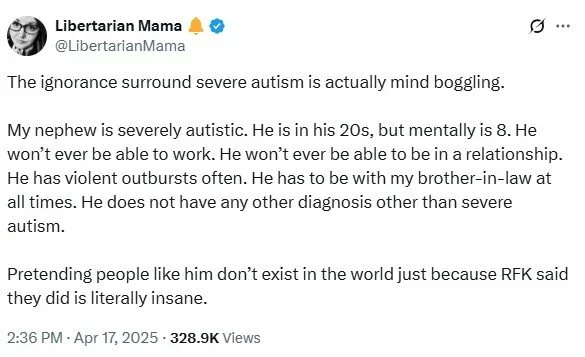
Consider the perspective shared in the wake of Kennedy's comments: A family member of someone with severe autism described their loved one's reality on social media: "The ignorance surrounding severe autism is actually mind-boggling. My nephew is severely autistic. He is in his 20s…He has to be with my brother-in-law at all times." This stark description wasn't meant to devalue her nephew's life—it was a plea for understanding the real support needs some individuals face. The truth is, her nephew’s inability to achieve conventional independence doesn't diminish his value—it highlights society's responsibility to ensure he receives the support he needs to thrive on his own terms.
This is not merely a philosophical debate—it has real policy implications. Our current disability support systems often prioritize employment and independence as primary outcomes, while underfunding the intensive support services needed by those who may never achieve these markers. We've created a framework that privileges the most independent while marginalizing those with the highest support needs.
The fundamental flaw in this approach is not that we celebrate independence—it's that we've allowed independence to become a prerequisite for human dignity. The true antidote to eugenic thinking isn't proving that disabled people can be productive; it's rejecting productivity as a measure of human value altogether.
This requires a radical reimagining of disability policy. Instead of asking "How can we help disabled people become independent?" — a condition the individual with disabilities may not even desire — we should ask "How can we create systems that support human flourishing in all its forms?" This means:
-
Developing metrics that measure quality of life and well-being rather than just economic productivity
-
Ensuring that advocacy messaging affirms the inherent worth of all people, regardless of their support needs
-
Creating funding mechanisms that don't privilege independence over interdependence
-
Building support systems that recognize care relationships as valuable in themselves, not just as stepping stones to independence
-
Acknowledging that higher support needs should trigger more resources, not less
The disability rights movement has long proclaimed "Nothing About Us Without Us." But we must ask ourselves: who is included in that "us"? When we respond to ableism by highlighting only those who can meet conventional standards of success, we inadvertently exclude those who cannot—or should not have to—meet these standards.
Breaking free from these patterns requires honest recognition of our own internalized ableism. When we rush to prove our worth through productivity, we reinforce the very system we seek to dismantle. True disability justice requires rejecting the premise that human value must be earned through independence or economic contribution.
As we craft policy and advocacy strategies, we must remember that every defense of disability rights based on productivity implicitly threatens those who cannot produce in conventional ways. The solution isn't to prove that disabled people can meet “typical” standards—it's to reject those standards entirely while ensuring robust support for those with the highest needs.
Our worth as human beings is inherent, not earned. Any framework that requires us to demonstrate our value through independence, productivity, or self-sufficiency is fundamentally at odds with genuine disability justice. It's time to move beyond the productivity trap and build a movement that truly values all forms of human existence—not for what they can do, but for who they are. In doing so, we must ensure that acknowledging support needs becomes a catalyst for increased assistance rather than a judgment of worth.
