Three Strikes... and He's Out?

What happens when the regular world has had enough of my son's autism

3 strikes collage jpg crop.png

[This piece is reprinted from a 2018 blogpost at Autism Society San Francisco Bay Area]

By Feda Almaliti

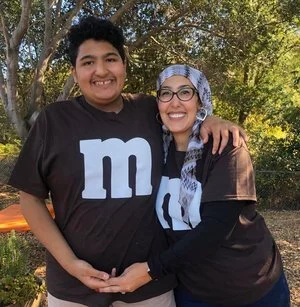
Oh Muhammed, or Mu, as we like to call him… my sun-shiny 13 year-old autistic boy, with his big smile, bigger hugs, and that mischievous sparkle in his eye. I’m literally kvelling just thinking about him. 

But the rest of the world? Its patience seems to be wearing thin. As I explained in a post last year, Inclusion Sucks, Or Why My Son Has Nowhere to Swim this Summer, Mu has the sort of autism that makes him welcome, well, not a whole lotta places. So naturally we’ve had another summer of rejection.

Here’s how it started. Mu can speak some sentences, though usually only when the planets and Ben & Jerry’s align, and even then he’s not understood by non-familiar listeners. Therefore he is considered functionally nonverbal. So to help him communicate he uses an Augmentative and Alternative Communication device (AAC). The AAC has been a godsend. It reduces his frustration and lets him bark at me like a regular teenager. His device shouts, “Want fries!" (his favorite vegetable) and “Want bubble water!” (In my experience, the word “please” drops from the English vocabulary between ages 13-17, autism or no.) 

And it’s not just about food. He can use it say, “Fix that!”— “that” being soap dispensers (three of them, yes, there must be three) when not placed at perfect 90-degree angles. Not to mention helping him medically, since he can usually use it to tell me where the “hurt” is. Mu wears the device pretty much all day long. It’s his voice, an essential. 

Now, Mu’s autism is really severe. He can be aggressive at times, have tantrums, and massive meltdowns. And when he does, you better believe the device is right there through it all. So our insurance policy includes getting a loaner during repairs. But recently the company that makes the device denied Mu one. Why? He was on the “Do Not Loan List.”

I mean I’m an Arab and a Muslim so I’ve totally heard of the Do Not Fly List. I’ve even heard of the Do Not Call List. But a Do Not Loan List? What’s the heck is that? Like a three-strikes law for autistic people?

"I'm an Arab and a Muslim so I've totally heard of the Do Not Fly List.... But the Do Not Loan List? What’s the heck is that? ​Like a three-strikes law for autistic people?"

I pleaded with the rep, telling him the AAC is his voice, not a vacuum cleaner! The rep still wouldn’t budge. Too many loans, and my son was Out.
 
Anyway, even without a loaner, Mu managed to ask to go swimming about 100 times. But guess what, we can’t go. Because, wouldn’t you know, we are also on the Do Not Swim List.
 
We recently took Mu to a nearby community pool, and let’s just say things didn't go so smoothly. We were asked to leave.

"Let's just say things didn't go so smoothly. We were asked to leave."

As soon as he blasted through the door, Mu jumped on, and broke, the pool’s handicap chair. Yes, you know that something that exists to make the pool more inclusive.

​I gotta admit… not cool Mu. That was way outta line and I laid it down to him. But believe it or not, that’s not why we were asked to leave. It’s because he was bothering the “moms and their young children” and taking “bites out of the swim noodles.” First off, I’m fairly certain there were chunks missing in the swim noodles when we got there—hey, it’s not like typically developing kids are all well behaved angels. And second, if allowed to return I would bring an armful of new ones as gifts—the Dollar Store is, after all, an autism mom’s best friend. But for now, it’s no AAC and no pool for Mu.
 
Now, I know what you are thinking—if Mu can’t behave in a way the public expects, at least there's help at home, right? 

Well, think again, because our behavioral agency recently put Mu on the Do Not Serve List.
 
After years of working with us they decided they wanted to drop Mu because they couldn't “appropriately” serve him (code for we don't get paid enough to deal with your kid). So, after much advocating we were able to secure help of another agency.
 
Then, within a week we faced another walkout. 

It started with the toilet. If something has a moving part, Mu will most certainly figure out a way to break it. It’s not that he means to or does it on purpose. He’s just very strong and doesn’t realize his own strength most of the time, some of the time, okay… all of the time. 

[Although I feel in a recent case he was plotting against me. Seriously, how did he even think to remove the toilet tank cover and stick in whole roll of toilet paper, then put the cover back on, and don’t even ask me what the plastic thing was in the middle of the roll. Again, not cool, Mu.]

Anyway he broke the toilet handle and tank so often our handyman finally insisted on installing a commercial version made of one solid piece.

Problem solved? Hardly, because then Mu broke off one of the sink handles, and then the doorknobs to the bathroom. Three strikes, again. ​​

Even the handyman had enough. He quit, too. Yes, the ultimate nightmare for us autism parents—the Do Not Fix List.

Inclusion is a hot topic in disability circles, but when our kids can’t play by society’s rules, inclusion can truly suck. Instead of some fantasy of joyful acceptance, we get black-listed. Over and over and over. How I dream of places, spaces and programs fully accepting of our special children. Autism-friendly rules, not “If you act autistic you’re out” rules.

 "Instead of some fantasy of joyful acceptance, we get black-listed."

With that in mind I end on a more positive note. At Autism Society San Francisco Bay Area’s Summer Pool Parties we make sure an autistic kid can be him or herself. Where they can chew on pool noodles, bellow and flop around, and no one judges them. ​So here we are, me in the burkini and Mu in his element. A place, however small, where everyone with autism belongs... on the VIP List. If only the rest of the world were so accommodating.

[End note. Please read before you send me hate mail. I believe all persons with autism should be accepted as they are anywhere they go, while I’m still holding out for my autism kibbutz or island. Whichever comes first. It’s all about choices. I respect everyone’s choices. Even yours.

And yes I’m a Muslim who likes to speak some Yiddish, okay? Kvell = to gaze upon with love and pride.​​

And finally, for those who don't like realities of autism discussed in public, I'm not shaming my son. There is no shame in behaviors one cannot control, it's like saying there's shame in a seizure for someone who has epilepsy. If you are ashamed for Mu, well shame on you.]

Feda Almaliti is Vice President of NCSA and Vice President of Autism Society San Francisco Bay Area.

Inclusion Sucks. Or, Why My Son with Severe Autism Has Nowhere to Swim this Summer

An autism mom stuck at home with her son on a hot summer day meditates
on the smallness of his world when inclusion is the only option.

Stock photo

Stock photo

By Feda Almaliti

It’s 95 degrees outside and I’m here at home with my little guy Muhammed. I call him my little guy because he is the youngest of my children, but little guy is 12 years old and already 5’10”. Muhammed has autism, the kind that most people don't like to talk about. He is constantly moving, vocalizing, and “fixing things” (because everybody knows that coffee mugs can only be on the left side of the middle shelf in the cupboard next to the sink, right?).

His language is limited but every other phrase is “want eat.” He is perpetually hungry, and did I mention he already weighs about 200 pounds? He finds solace in watching Dora videos, which he requests about 100 times a day. He grabs food at times when he’s not supposed to so we nicknamed him “Swiper the Fox,” but unlike the cartoon character he doesn't stop when we say “Swiper, No Swiping!” three times. He can charm the pants off you once you get to know him, and he is legit the coolest kid I know, and believe you me I know A LOT of kids ;).

Muhammed is never going to be a Sheldon or pass as a quirky kid with autism. He has his awesome days and the not so awesome ones where he’s a whirl of mental and physical chaos. But this boy has a calm and happy place, and it’s smack in the middle of a cool blue pool. But like most autism moms, I don't have a pool. I will not be blessed with a pool anytime soon unless some reality show takes pity and surprises me with an Extreme Backyard Makeover.

So, given the stifling weather and the long weekend day ahead, I desperately want to take him swimming, but where can I go? In theory we could hop to a public pool, Y, hotel, or friend’s house. But reality is hardly so accommodating. No matter how much we may opine that severely developmentally disabled people like Muhammed deserve equal access to the community (which they absolutely do!) invisible signs everywhere tell us to "Go away."

Let’s face it, when he’s having one of ‘dem days, people don’t want kids like Muhammed near their calm and carefully maintained pools and manicured gardens. He scares little kids. He scares adults. He might take off his bathing suit in public. He sometimes pees on the ground when we can’t get to the bathroom fast enough (it would be better if he did it in the pool like everyone else though, and don't pretend your kid doesn't). Sometimes he grabs strangers' food and eats or throws it. He annoys other pool-goers as he “sings” and yelps unintelligibly.

So, as you can imagine, we get evil stares. We are treated rudely or asked to leave. And he's not exactly invited back to my friends' pools. They are worried about "liability" or "disturbing the other tenants" or neighbors. Even my famous homemade hummus is not enough to persuade people to reopen their doors. So here we sit, dry-docked while the rest of the world frolics in the blue. Thank god at least we have air conditioning.
 
The idea of full inclusion is all too often an illusion for severely autistic people like Muhammed. Heck, if he attended a conference about autism discrimination he'd be kicked out in two minutes. So we should be alarmed by the rise of the militant inclusionista ideology that says no matter how profound their cognitive impairments or disruptive their behaviors, people like Muhammed should be included in the mainstream of community life at all times instead of "segregated" in special programs designed for them.

Segregated. Ouch, it sounds like such a horrible word. Brings to mind Jim Crow and whites-only drinking fountains.

But that's not what I'm talking about. I'm talking about self-imposed segregation …like nudist colonies, senior living facilities, women-only gyms or even smoking lounges in airports. Gosh, how I yearn for it. How desperately we need it! I literally have dreams of an autism island, but I'd totally settle for an autism kibbutz.

I imagine programs and places, away from the rules and consternation of the general community, where all of Muhammed's exuberance was welcome. Where he could be safe, and be totally himself, splashing and yelling to his heart's delight. This sort of positive segregation would open doors for Muhammed, instead of closing them.

"Heck, if he attended a conference about autism discrimination 
he'd be kicked out in two minutes."


Of course my pool predicament is a microcosm of a bigger problem: disability-friendly day programs, jobs, housing, and therapeutic care—vital lifelines for parts of our population—are at risk given the direction of federal policy. The trendy mantra is "community integration" while options for the severely disabled slowly disappear into the black hole of red tape and de-funding.

It’s not that I don't want my son to be included, to the contrary, we work with him at home every day, and let’s not forget the various therapists, aka uncanonized saints, to come closer and closer to that goal. But I’m a realist, and Muhammed will never live independently in the community and I’m never going to be the next Beyoncé. So, if inclusion is the only answer for Muhammed, his future will look like today: isolated inside our house, with nowhere to go.

"But I’m a realist, and Muhammed will never live independently in the community
and I’m never going to be the next Beyoncé."

They say, “Why maintain an autism day program when Joe could just go to the local Y?” or “Why have sheltered workshops when Sam can get a competitive job at Safeway?” Please tell me, what are these people smoking and in which smoking lounge can I find them? Have they ever tried caregiving for someone like my son? 

So let's make a deal. Let's ensure inclusion and integration for all those who want it. And let's support acceptance of all, including acceptance of alternative options for the Muhammeds of our world. Don't let narrow ideology throw our babies out with the bath, or, er, pool water. It's just common sense. In the meantime if you'll invite us over for a swim, we'd appreciate it.

(This is only MY opinion obviously but undoubtedly some people will misinterpret this piece to mean I believe that all people with autism should be segregated from the community, which I am not saying nor implying nor do I believe! But let the hate mail begin in 3, 2, 1….)

Feda Almaliti is an autism mother who lives in the San Francisco Bay Area.  This blogpost was reprinted based on the original 2017 post at Autism Society San Francisco Bay Area.

Coronavirus Crisis: NCSA's Feda Almaliti on NPR

THE CORONAVIRUS CRISIS

'He's Incredibly Confused': Parenting A Child With Autism During The Pandemic

almaliti-family_custom-09cdd39cdf2ebac0e6769d2739c2c27265414d07-s300-c85.jpg

Thank you to NPR’s All Things Considered for speaking with NCSA Vice President Feda Almaliti about how the stresses of the coronavirus crisis on families with severe autism.

———————————————

Living with the pandemic has been difficult for everyone: the isolation, the need to wear protective gear like masks and gloves, the adjustment to working or learning from home.

For those living with or caring for someone with severe autism, those challenges can be exponentially more difficult.

"Wearing gloves or masks, you know, things like that? That's just not going to happen here," says Feda Almaliti….. Hear the radio program on NPR here

CDC Study Estimates 2.2% of U.S. Adults Have Autism — Don’t Believe a Word of It

The paper’s adult autism numbers are wildly overblown, and worse than useless.

cdc.jpg

By Jill Escher

Autism research has long been something of a spectacle. For every study that actually moves the field forward, it seems a dozen are fairly worthless, same-old same-old, or totally bizarre.

But I never expected that work from our own U.S. Centers for Disease Control (CDC) would fall into that last category.

This week the Journal of Autism and Developmental Disorders published a paper, “National and State Estimates of Adults with Autism Spectrum Disorder,” by the CDC’s Patricia Dietz, Charles Rose, Dedria McArthur, and Matthew Maenner. The news sites blared across the internet: “First United States Study Of Autism In Adults Estimates 2.2% Have Autism Spectrum Disorder,” or “CDC Researchers: Over 5 Million US Adults Have Autism.”

But the study estimating a supposed 2.2% prevalence in adults, was, how can I put it mildly, utterly preposterous.

It was, in essence, nothing more than a glorified back-of-the-envelope type of exercise that did not actually look at any data pertaining to autistic adults. Rather, it used data for children with ASD and, adjusting for mortality rates, projected what adult rates might be based on current childhood rates.

The obvious flaw? The method was based on the fundamental assumption that the birth year autism prevalence is constant over all ages considered, going back to 84 years before 2017. Yep, they assumed autism rates were the same in 1933 as 2017, and all years in between.

Never mind that there’s not a shred of evidence for this — not in medical, academic, institutional, military, court, social security or any other records, whether pegged under autism or any other label. And never mind that the CDC itself has published numerous studies indicating increasing autism prevalence over successive birth years.

But apparently at the CDC it’s cool to ignore actual facts. So, simply assuming current rates apply to all ages, even 87 year-olds, the paper estimates that in 2017 the U.S. adult prevalence of autism was 2.21%, or 5,437,988 U.S. adults (!) aged 18–84 years. Five and a half million autistic adults? What? How? Where?  Anyone with eyes can see that’s just not true.

It also estimates the states with the greatest number of adults with ASD included California, at 701,669 cases, Texas with 449,631, New York, with 342,280, and Florida, with 329,131.

Validity check, anyone? These numbers are absurd on their face. For example, in California we obviously have nowhere near 701,669 cases of adult ASD.

Calif DDS Autism Birth Year.png

California is known for maintaining the country’s best records on autism in the population. In our Department of Developmental Services (DDS) there are currently about 39,000 cases of autism for ages 18 and up. Outside of DDS, which would include milder cases ineligible for developmental services, the population has been estimated to add about 30% more than that number, so perhaps we have about 50,000-60,000 total adult ASD cases. It boggles the mind that any researcher who knew anything about autism in the real world would estimate that California has 701,669 diagnosable adult ASD cases.

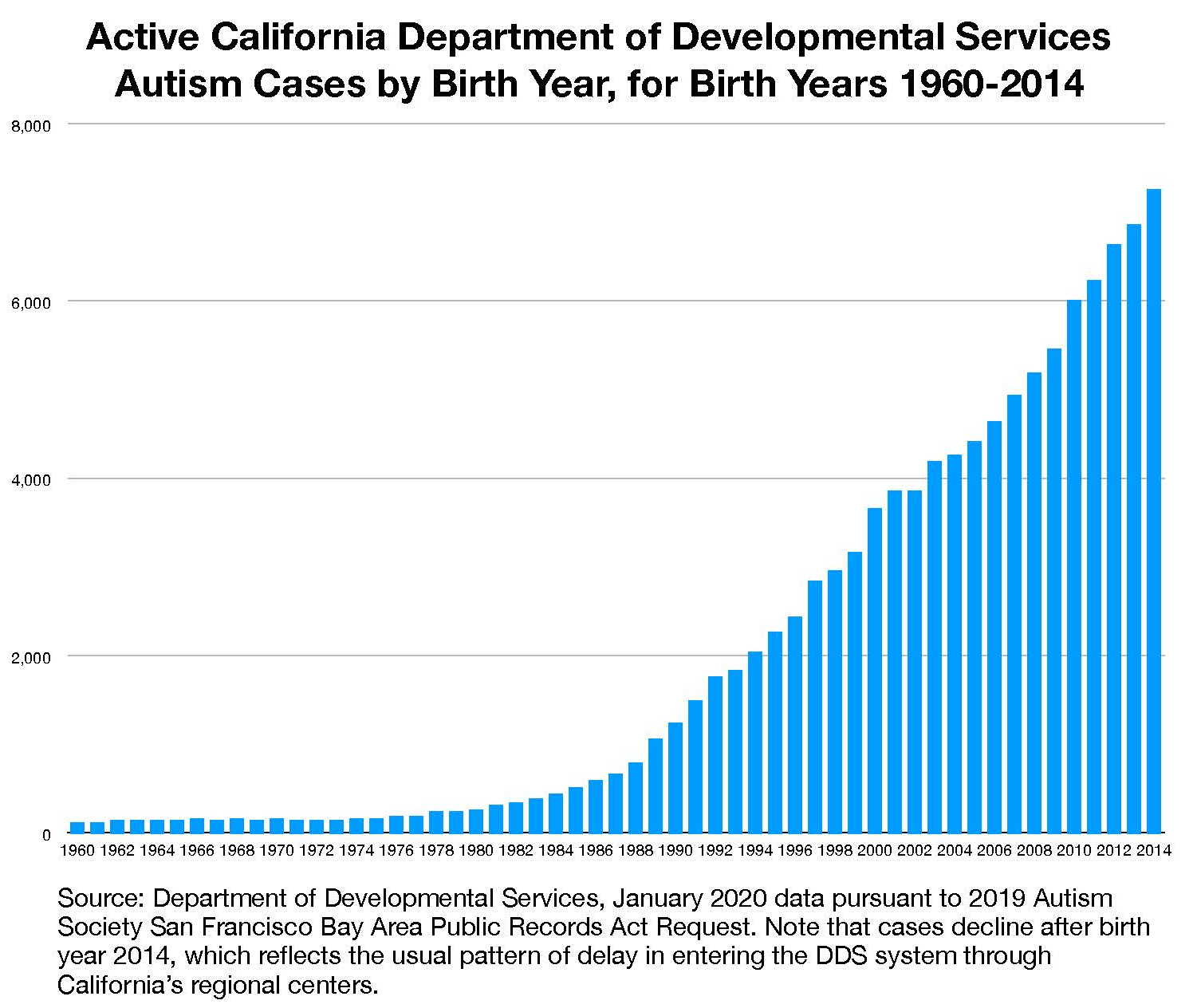
Moreover, California has kept close tabs on autism for many decades. And what does that data say about autism by birth year? That the rates have skyrocketed beginning with births in the early 1980s, something even the California Department of Public Health has verified in prevalence studies. The graph to the left shows the DDS autism cases by birth year: about 200 per year through the early 1980s to more than 7,200 by 2014. In other words, real-world data show unequivocally a massive upsurge in cases over time.

In fact, DDS data show there are only 4,000 developmental disability-qualifying autistic adults born before 1980 in the entire state. If rates remained constant over time, as the CDC suggests is the case, the state would have about 250,000 such adults instead of the actual 4,000. But there’s not a shred of evidence our robust system has missed even a tiny fraction of the supposed 246,000 missed cases.

So, how did this new CDC paper get away with such absurdities?

The authors say they assume ASD prevalence among children and adults (of all ages) is similar because there is no evidence that environmental factors associated with ASD have changed over time. They say “few risk factors have consistently been associated with ASD and those that have been identified have accounted for a very small percent of increases in diagnosed ASD.”

Actually, they are correct, to a point. With rare exceptions (like fetal exposure to anti-seizure medication and prematurity), exposures investigated to date (and this includes vaccines, which obviously do not cause the dysregulated brain development of autism) cannot explain the colossal increases in autism witnessed across our country.

But — and I can’t believe this needs stating — it makes no sense to dismiss an increase by birth year simply because you don’t know what caused it. That’s like saying that people were not getting sick and dying of Covid-19 if we didn’t know what caused it. Or children were always born with high rates of microcephaly because we didn’t know about Zika. 

Epidemiology works the other way around, of course. First you identify changes in disease incidence, which for disorders like autism means birth year prevalence, and you use that information as a clue as to causes. The CDC’s role is to identify risk factors driving pathologies afflicting Americans. But in a move that should outrage anyone who cares about autism, it is now waving the white flag of scientific surrender, saying basically, “We don’t know what is causing this autism increase and we assume there’s nothing more to discover.” An abdication of its core responsibility to the U.S. people.

In the good news department, it seems this paper had some noble intentions. “National and state-based estimates of adults living with ASD could inform planning for programs,” say the authors. And yes, we desperately need policymakers to understand the prevalence and number of cases so we can support the legions of disabled adults. But this study offers nothing of value, and, worse, signals an alarming level of apathy about causation of very serious neurodevelopmental pathology that has flooded our communities.

Jill Escher is founder of the Escher Fund for Autism, which promotes research in the genetic toxicology of autism, GermlineExposures.org. She is also President of the National Council on Severe Autism and Immediate Past President of Autism Society San Francisco Bay Area.

Disclaimer: All blogposts on NCSA represent the views of the authors and are not necessarily the views of NCSA.

In An Instant, His Face Changed, and No One Heard My Cries for Help

To promote #AuthenticAwareness, a mother of a son with severe autism shares the enduring trauma of a brutal attack

By Janie Brown

As a very private person, this is difficult for me to write, but I am doing so for the opportunity to help others understand the challenges that severe autism presents. My son is 18 years old. He tests as an 18 month old socially, and 1 year 9 months verbally. He is a loving, sweet young man the majority of the time, but there is always a sense of  looming instability.

There have been too many instances of aggression for me to describe in detail, so I will share the most recent one, the one that shook me to my core.

Last month, I was at home alone with my son. He was bouncing on his yoga ball, listening to his songs on his iPad. I was cooking, and keeping a close eye and ear on him. He came into the kitchen, and sat on the floor. It seemed that he wanted my attention, so I sat on the floor next to him, and proceeded to give him tickles, kisses, scratches, and back rubs…. That's when it happened, in an instant, his face changed, and his pupils dilated. He grabbed a hold of my hair with both hands. I was unable to get out of his grip, and he would not relent.  

The hair pulling turned to hair ripping, then to scratching, and then to biting, as I was pinned to the floor by all 6 feet, 200 pounds of him. No one heard my cries for help, and I just prayed to God to give me one second to get out of his grip. 

About 10 minutes into the attack, as his teeth drew blood on my forearm, I was able to push him off to get away. I ran upstairs, not sure how, and locked myself in my room. I called my husband, and couldn't even speak into the phone.

By the time he arrived, my son had settled, but I hadn't. One month later, I still haven't.

If I had been mugged in the street by a stranger, it would certainly leave a lasting impression… but I would have learned to do things differently… maybe I wouldn't walk down that street anymore, maybe I would learn to walk without a purse, maybe I would always make sure to walk with a friend for safety. But, when it's your child, in your own home, there is no certainty, and prevention isn't foolproof.

I am always on edge, expecting it to happen at any time. Even a seemingly "good day" is no guarantee. I love him with all my heart, but I can't put this event completely behind me… even with the sixth medication added to his daily regimen… even with my oldest son sacrificing his leisure time to make me feel safe in my own home. There's always a sense of impending doom… a sense of failure… a sense of surrender because of all the medications his psychiatrist prescribes that I reluctantly dispense... most days I feel that failed as his mom.

My son is a joy to us all. He has the sweetest smile, and the most innocent interactions. He still loves his teddy bears, Baby Einstein, and something as simple as "clapping."

When he “snaps," it’s not him. We can't ease his fear/panic/loss of self control. It's the saddest thing to see my son lose himself, and be unable to help him. I just hope he feels how much we adore him, and I hope he knows that all we do to prevent these outbursts from reoccurring is the only way we can help him. I pray that the newest medication he has started will stop these outbursts, but I also wish it didn't have to come to him taking psychotropic medications with side effects he can't express.  

I hope that with enough understanding and awareness, individuals like my son and their families will be able to obtain the help they deserve.

Thank you for the opportunity to be able to share a piece of our lives.

Janie Brown is a pseudonym for a mother of a severely autistic son.

“Blame it on autism”: Underlying medical problems in the severely autistic often get overlooked

An autism mom says #AuthenticAwareness means knowing medical problems often go under-diagnosed and untreated.

By Judy Talbot

My daughter is 36 and has autism. When she experiences a significant increase in behaviors, we suspect some underlying medical problem. Unfortunately, our experiences in emergency rooms have tended to blame her behaviors on her autism.

One time she kept saying, “Ow that hurts,” but would or could not say what specifically hurt, except it seemed to be somewhere near her stomach.

At the ER, the doctor would push and ask if it hurts. She says, “Yes.” They push another place, and again she says “Yes.” After a while the logic seems to be, Oh there isn’t anything wrong, it’s just typical autistic behavior.” 

I explain that no, she has a high tolerance for pain. After some time, and with my persistence, her primary doctor ordered a PIPIDA scan to view the liver, gallbladder, bile ducts, and small intestine. And… it showed her gallbladder needed removal immediately. All that time with her in all that pain, I wished the test was run in the ER, instead of blaming autism. 

Another time, my daughter's behaviors were blamed on autism, but some time later, when she was having a sonogram for incontinence they found she had a cyst the size of a grapefruit on her ovary. Again, surgery needed.

During many of my struggles physicians have advised me to medicate her, basically, drug her until she shuts up. Too many drugs (eg, antipsychotics) were tried yet nothing helped. In fact, a medication she was on caused pancreatitis, and by the time the doctors finally believed me that her behaviors were not ordinary, they found she was suffering necrotizing pancreatitis. And it almost killed her. 

I realize that not all behaviors are caused by physical pain, and that every person with autism is different. But what I do know is that we must find better ways to diagnose non- or minimally verbal patients. Clincians who have the patience and skill and willingness to treat our kids are a rare breed, and our children are paying the price.

Judy Talbot is the mother of an adult daughter with autism.

Military families with autistic children face uprooting, isolation, and continuous loss of services

#AuthenticAwareness includes knowing the additional challenges faced by military families living with severe autism

By Jennifer Penhale

A large number of families within the active duty military population have children with autism. Some of these families will move every few years and with that comes a whole host of challenges. We are an active duty Air Force family with three children on the autism spectrum (our twin teenage daughters being on the severe end). We move every few years, sometimes more than once a year, and at 16 years of active duty service, we have now moved seven times to six different states with one more military move left to go.

Every time an active duty military family with autism moves, that family is effectively starting at square one in finding new providers and launching a new IEP process. These families often face extensive wait lists and the majority of the duty locations are already saturated with similar families making it that much more difficult to secure needed services.

Add to that the “available” providers making the decision to exit the military insurance network leaving a very small pool of medical and therapy providers to go around. In addition to the stress of scrambling for services, these families find themselves with no built-in support, no friends and family. IEPs from previous states are often not recognized and honored, and the level of special education support and resources can be dramatically different. For children with severe autism, there are no real alternatives to the public school system. Charter and private schools, even private autism schools and homeschool co-ops, can refuse to enroll students with severe autism.

My daughters were denied acceptance to five private autism schools in Florida based on the fact that they needed 1:1 assistance and were an elopement risk. My youngest son with mild autism was accepted without question. For many of us, homeschooling has become our only option in order to ensure their safety and well being and a chance at academic success. I have had to homeschool for the last five years due to the unwillingness of four school districts in three different states to comply with federal law and provide a free and appropriate education to my daughters. 

We do not have the financial means to file due process, hire a good lawyer, and hope for the best. Some of us have been in a battle against some of the largest school districts in the United States. I personally battled against the 8th and 11th largest school districts in the nation; in Florida and Virginia. I knew full well that I could not successfully take on such a large entity without an arsenal of lawyers and funding. Our family, like most military families, would be moving before any resolution would possibly be reached. School districts know that and simply play “wait us out.”

The argument can be made that military life and autism don’t mix. But these families are also some of the most resilient you will encounter. They deploy and take on additional duties all the same. After living all over the country, we have met other families who are also dealing with challenges and hardships severe autism brings, compounded by the continuous uprooting. The isolation and loneliness can be overwhelming.

We military families have been advocating for more awareness, and better funding and accountability on the part of the Department of Defense. We fight for Medicaid portability among other things important not just those who have severe autism, but for all who have developmental and medical needs. 

My story is sadly the norm. We just wake up each morning and pray that we have the physical, emotional, and mental strength to just make it through the day… the evening… into the overnight hours, and to the sunrise of the next morning. But we must advocate to members of Congress for the needs of our children. Those who serve in the military should not feel that they must hang up their uniform because their children have severe autism. 

Jennifer Penhale, MPA, is the mother of three children with autism.

"I wouldn't wish my brain on anybody"

#AuthenticAwareness includes knowing the struggles inside the mind of an autism self-advocate

The author at one of his speaking engagements.

The author at one of his speaking engagements.

By Russell Lehmann 

As a motivational speaker, author and poet, I travel for work quite frequently. Oftentimes, to get from the airport to my hotel, I will take an Uber or Lyft. Inevitably, the drivers ask what I am in town for, and when I tell them what I do, they subsequently ask me what I speak about. 

I hesitantly say autism and mental health, not because I am embarrassed or ashamed, but because I know what the driver’s response will be: “Oh wow, I would have never guessed YOU have autism! You must be doing very well!” I give a half-smile on the outside, while frustration fills my inside.

Individuals with autism are at a significantly increased rate of having a mental health diagnosis. I have 8 invisible disabilities, and usually, aside from massive public meltdowns that have taken a toll on my well-being, only those closest to me see my struggles. 

The driver taking me to my hotel doesn’t see my meltdowns at home where I shake, rock back and forth, screaming at the top of my lungs while cussing and punching myself in the head. 

My followers online don’t realize the excruciating thoughts that consume my mind, such as suicidal ideations and disturbing intrusive thoughts stemming from my OCD. 

My neighbors aren’t aware that every day is a fight to get out of bed. Sometimes I don’t, and when I do I want to run away from being misunderstood, not fitting in with society and being extremely isolated and lonely. 

Very few know of my past hallucinations, because even though I take pride in being extremely transparent and authentic, there is still too much stigma for me to walk around telling people how terrified I was when I was sobbing on my floor while the devil was yelling at me. 

I can excel at the extraordinary, but I struggle with the simple. Do not for one minute think I have it “made” due to the nature of my career. I have not “outgrown” or “overcome” autism or my challenges. To be honest, I wouldn’t wish my mind on anyone unless they were readily prepared for it. 

Indeed, I have beaten the odds and continue to do so every day due to my tenacity and perseverance, but don’t let that paint a false narrative. I still struggle vehemently, I get severely depressed, I get discouraged with the lack of compassion and understanding and I cry almost every other day. 

This world is too harsh for me. However, my heart and soul drive me to speak up for others who are not heard, because I know how challenging and hurtful it is to go unnoticed. 

Always remember this line I wrote a few months ago, and that I continue to find to be more and more true with each passing day: “What you do not see is much more important than what you do see.”

Learn more about Russell Lehmann at www.TheAutisticPoet.com and on Instagram at @autism_advocate_

My Autistic Daughter Swallowed Ball Point Pens: A Story of Severe Pica

#AuthenticAwareness includes attention to this life-threatening condition, which is common in cases of severe autism

pens rainbow.jpg

By Kelly Olson

My daughter Kayla is about the same age as Greta Thunberg, but the poised and articulate climate activist’s “autism” bears no resemblance to my daughter’s. 

In a split second, Kayla will swallow whole objects intact, like you might see someone do in the circus. A big rock, batteries, chunks of soap, nails, an Allen wrench, baby lizards or bugs, she’ll pick them up and eat them. She used to break glass on purpose so she could eat and swallow the shards. To this day most of our dishes we use daily are made of unbreakable plastic or melamine. 

From an X-ray finding batteries inside Kayla’s abdomen.

From an X-ray finding batteries inside Kayla’s abdomen.

Pica, as this behavior is called, is a common feature in autism. It refers to the ingesting of non-edible objects like dirt, rocks, glass, paper clips, paper, plastic, and/or basically anything else you can imagine. Items may be relatively benign such as grass, leaves, paper, or more harmful such as rocks, household cleaners, etc.

For many, pica can be a horrifically serious compulsion, leading to choking, poisoning, or blockage or perforation along the gastrointestinal tract. Emergency Room visits, X-rays, CT scans, blood draws, frantic calls to Poison Control, and surgeries for repair or object removal are all part of life for families like mine. 

In one particularly tough year, My daughter had so many X-rays and CT scans done in search of swallowed foreign objects, I was surprised she didn’t glow in the dark and seriously worried about the long-term effects of her being exposed to so much radiation at a young age. In addition, I have learned so much from calling poison control, like exactly how many tubes of toothpaste, deodorant, etc. one can eat before it becomes truly dangerous. 

For years, I have lived in a state of intense hyper-vigilance while we’re out and at home. Except for sleeping — which is something she very often doesn’t do — there is no downtime, no respite from pica. Several times a night I am awoken by the door sensor alarm that lets me know she has left her bedroom. It only takes a moment for her to grab something and swallow it. At school she has a 1:1 aide who is always an arm-length away. But the vigilance continues to the other end, too. You don’t want to know how much time I have spent fishing items out of her poop to make sure they’ve passed.

To add an extra scary twist to Kayla’s pica behavior, Kayla has a compulsion to swallow large items whole. She will even pretend to chew her food just to swallow it in large chunks on purpose, as if she seeks some unmet sensory need. Even when eating appropriate food items we have to watch her very closely and make sure her food is cut up in small bite-size pieces and prompt her repeatedly to chew her food during each and every bite with each and every single meal. It is tedious, but necessary.

Unfortunately Kayla seeks out this sensation when engaging in pica. I have witnessed her pick up a large rock that you would think impossible for any human to swallow get tossed in her mouth and disappear as easily as an m&m in an instant. This behavior has always been an issue since she was a toddler. It’s as if she never moved from the toddler stage where they put everything in their mouths, and it just got worse and worse each year. 

Images from the endoscopic removal of the pens.

Images from the endoscopic removal of the pens.

Kayla’s pica was at its worst when she was about eight and nine. Because Kayla likes drawing and I could not let her use crayons or markers (she eats crayons and marker tips) I thought I would get her some colorful gel ink pens. I found a pack of five at a dollar store. There were smaller pens, maybe about four or five inches each, but pens nonetheless. I sat on the chair adjacent to the sofa and placed some paper and the pens on the coffee table in front of her while I checked some emails on my laptop. I must have looked down at my computer for 20 seconds and by the time I looked back up, the pens, all five of them, were gone. 

I asked Kayla, “Where are the pens?” and she indicated to me that she had swallowed them. “There’s no way, that’s not possible,” I thought to myself as I frantically searched under the sofa and flipped over all the cushions. No pens. So I just calmly got her dressed and took her to the emergency room where an X-ray revealed the metallic tips of five ball point pens. We were then transported to Methodist Children's Hospital by ambulance where she had endoscopic surgery to remove them from her stomach. 

Fortunately the surgeon was able to retrieve the tips of the pens with the tool and did not actually have to cut into her abdomen. After the surgery the doctor showed me the image of the pens in her stomach, my jaw dropped. I guess I was still somewhat in disbelief. But seeing is believing. That's why I make a point to show new teachers, camp counselors and other care providers of hers, images of these pens. Because I think when I say “pica” people think maybe she chews on a piece of paper now and then or eats dirt or grass or leave — not things that require emergency room visits. I need them to wrap their heads around the danger my daughter faces each day. This is life-threatening behavior.

Kayla is like Houdini, able to get her way into anything, so as you can imagine, everything is locked up at our house. We have locks and or alarms on doors, cabinets and the refrigerator.

I sought help everywhere, but no one in Texas was willing or able treat her. So about six years ago I admitted her to the Neurobehavioral Unit at Kennedy Krieger in Baltimore for several months. As a single mom, I was desperate and exhausted and totally out of options. A combination of behavioral treatments and medications has helped reduce the pica, but I remain in a state of constant vigilance, and a weariness compounded by Kayla’s hyper-energetic inability to sleep. Kayla made excellent progress during and after her inpatient stay in Baltimore. Her pica behavior decreased dramatically. However we are not 100% out of the woods. It is an ongoing work in progress but I hope as she matures and we continue our best efforts to provide the appropriate behavioral support we can eventually eliminate this behavior.

Despite her progress, we still have to take precautions to keep her safe. Kayla is like Houdini, able to get her way into anything, so as you can imagine, everything is locked up at our house. We have locks and or alarms on doors, cabinets and the refrigerator. I’ve had alarms, home camera systems. In the bathroom I couldn’t  leave anything out, even toilet paper, shampoo, soap, or deodorant, because she would ingest them. 

The situation has since improved somewhat, I can now leave certain things out I know she has no taste for, but basically the bathroom is literally empty except for towels and toilet paper. I even have to cut out the magnets from the shower curtains liners as she will remove them and swallow them. She even figured out how to pick locks on my bedroom door in order to seek out all the aforementioned toiletries I have stored. 

You cannot sweep from your mind the thought that this is how my kid is going to die — she’ll choke or get poisoned. There is no replacement behavior, she seeks the sensation of a whole object going down her esophagus.

While the world celebrates the Gretas of the world, it turns its eyes away from the Kaylas. But there is a generation of young people like my daughter who desperately need help and need the world to know their stories, too.

After I remarried last June, we moved into our new house and the enormous added costs of living with severe autism once again hit me. To cite just one of many examples, we had to pay $1,000 to have an highly toxic oleander tree removed from the backyard for fear Kayla would ingest its potentially deadly flowers. Also, the renewed sense of missing ordinary, normal things, like wondering if I’d ever be able to buy a regular wine glass.

But mostly I know this autism behavior, like her eloping, could kill her. While the world celebrates the Gretas of the world, it turns its eyes away from the Kaylas. But there is a generation of young people like my daughter who desperately need help and need the world to know their stories, too. 

I will never give up on my daughter, and will try every tool I can to keep her from swallowing things that aren’t food, but I am also consumed by fear. I’m not going to be around forever, and no one else will be her helicopter mom. Our vulnerable, disabled autistic kids, they deserve the cover of Time magazine, too.

Kelly Olson is the pseudonym of an autism mom who lives in Texas. Kayla is a pseudonym for her daughter.