Another rug bites the dust: the collateral damage of severe autism

The daily tumult of autism can discombobulate a home and drain a bank account.

messy-stuff_orig.png

By Jill Escher

Where did all my kitchen rugs go? It’s 3.20 in the morning and as usual, I’m awake. Not by choice but because, like clockwork, my sweet, nonverbal 18 year-old son with autism woke at 3 and started running, some might say rampaging, around the house. Boom, clomp clomp, tap tap tap, whoosh door opens, slam door closes, ugh.

I pat around my nightstand, reluctantly find my glasses, and head downstairs, not knowing what mischief may have transpired over the past 20 minutes. These wee-hour melees can be a bit like a suspense scene in a not-very-scary horror movie. Open the door… what will we see… probably not a severed head… but….

And there it is. My kitchen rugs are gone.

Jonny’s sitting at the kitchen table with a big grin and four iPhone 3GS’s splayed out before him. Shredded parmesan, once neatly bagged in the still-open fridge, is strewn over the table and floor, as if some yellow snow had fallen from the light fixture. With a well chewed pink toothbrush he taps at his iPhones, all synced to that 1979 tune, My Sharona.

Well, I'm happy he's so happy, but... my half-awake head buzzes, “Where are my rugs rugs, rugs rugs rugs, where did they go go, go go go? My Sharona.”

Over our north neighbor’s fence? Over the east one, aka the Corner of No Return? In the hot tub? It’s now 3.25 a.m. and I’m not exactly in the mood to treasure hunt floor coverings. And I can't help but wonder, Oh great god of missing rugs and whatnot, what reverse jackpots will the chaos of autism bring today?

"What reverse jackpots will the chaos of autism bring today?"

Depending on the mood, strength, and obsession du jour of the individual, the daily collateral damage of autism can be staggering. What amazes me is that these types of bills don't even show up when the experts talk about the costs of autism. (See, for example this 2015 study out of UC Davis, which did include lost productivity in addition to care and medical costs.) But we really need to talk about them because they can hugely impact families' quality of life and financial well being.

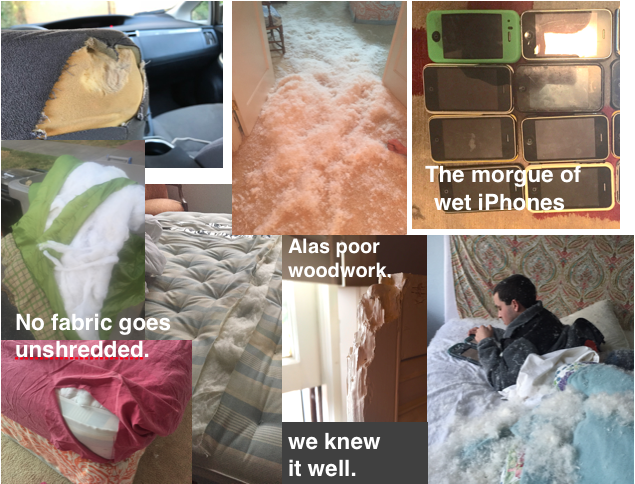
Just to illustrate how high this officially invisible toll of autism can be, a recent day at our home went like this. About $90 for a new sheet set to replace the otherwise perfect set he shredded (the 19th replacement of the year). A $120 iPad and iPhone repair bill. I do not exaggerate when I say that some weeks we’re a patient of Phone Doctor of San Jose every single day. Then add $240 for the housekeeper because I hardly have time for the Sisyphean task of cleaning up after my main man. In the late afternoon, add $225 for the handyman to replace the cracked casing of a door that had the misfortune to come between Jonny and his cherished iPhones. Finally, just as I looked forward to using them at the ice rink with my autistic daughter that evening, I found my new iPhone 7 earbuds torn into pieces, and poof! goes $29. In all, our daily autism-damage bill can easily top $500.

“In all, our daily autism-damage bill can easily top $500.”

Mattresses shredded. Upholstery ripped. Drywall bitten. Paint peeled. iPads shattered and iPhones dunked. Keys snapped off our piano and MacBooks. Window screens pushed out from their moorings. Down pillows punctured, with the nightmare of tiny feathers settling in all corners. Rugs denuded of their pile. Jackets ripped, shoes chewed, sweatpants with holes the size of grapefruit. Shutter slats chewed, askew and broken, giving our home a whiff of Haunted Mansion. The car’s seat gouged into a mini crater of foam.

To be abundantly clear, I don't blame my beloved son one bit. Not a speck of this Tasmanian Devilishness is his fault. You will not find a kinder or sweeter soul on this planet. He deserves the Nobel Peace Prize just for being him. It’s simply a matter of short-circuited brain wiring — blaming him would be like blaming someone for having seizures.

But understandable though it may be, no one can ignore a bill for material casualties easily exceeding $25,000 a year. If we counted all the child care, social services, schooling, therapeutics, and specialized camps and recreation, we’re talking an annual Autism Bill of many multiples of that. And that doesn't even encompass our Double Bill, as we have another child with nonverbal autism as well.

“No one can ignore a bill for material casualties easily exceeding $25,000 a year.”

For many families, massive expenses like these are just the start of their reverse lottery. Often parents must sacrifice a job, and the entire income stream that came with it, to care for children or adult children. They become unable to save for their own retirements as every excess penny from this dried up cash flow gets diverted to the never-ending Bill. The financial damage of autism can be devastating, even a one-way ticket to poverty. And now the situation seems poised to get worse.

I know, groan, these are not fun topics. Wouldn't you rather just binge watch "The Good Doctor," with its autistic genius protagonist? Perhaps instead of indulging in sugar-coated fantasies, turn your attention to the hundreds of thousands of families in our country living with harsh and often bank-draining realities of severe autism.

As I edit this blog I get a text from a friend. Her large autistic son just broke her bed, after recently breaking his own, which they had reinforced multiple times with heavy lumber and bolts, to no avail. Two beds dead. Two mattresses with mushed springs. Her Autism Bill of the day started with a whopper of about $2,000. Not to mention all the family's lost sleep and time she must devote to restoring habitability to her home.

Just before dawn, I spy my rugs over the north fence, alongside a pile of missing sheets and towels. Phew, no shopping today, just a retrieval mission. But then my gorgeous Jonny, skipping with his abundant energy and joy, darts into the front yard and yanks the rear windshield wiper off my car, breaking the arm. Ka-ching! And it’s only 6 a.m.

Jill Escher is President of the National Council on Severe Autism, Immediate Past President of Autism Society San Francisco Bay Area, founder of the Escher Fund for Autism, and a housing provider to adults with autism and developmental disabilities. She is also a former lawyer and the mother of two children with nonverbal forms of autism. [A version of this post first appeared at the Autism Society San Francisco Bay Area blog.]

Disclaimer: Blogposts on the NCSA blog represent the opinions of the individual authors and not necessarily the views or positions of the NCSA or its board of directors.
Prevalence of autism up in schools across the U.K.

Rate more than doubles in Northern Ireland, Scotland, England and Wales

 
UK asd prevalence jpg crop.png
 

By Jill Escher

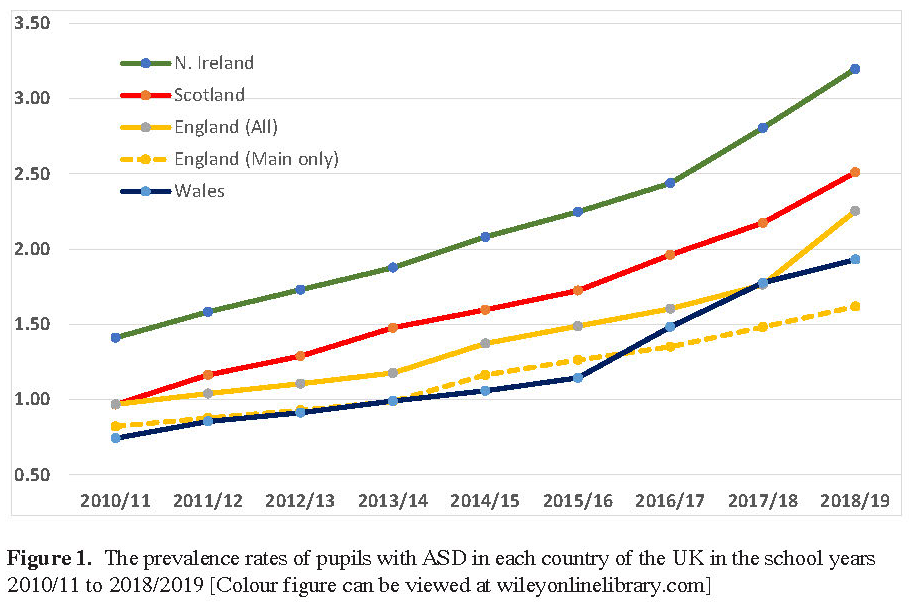
A new report on autism in U.K. schools indicates sharp increases in prevalence rates over a nine-year period through 2019. The report saw autism rates climbing in all four countries of England, Wales, Scotland and Northern Ireland.

Northern Ireland had the highest prevalence throughout, reaching 3.20% of all students by 2018/19, more than double 1.41 nine years prior). The lowest rate in 2019 was 1.92% in Wales, a number that aligns with the rate seen in a recent study of U.S. children by the CDC. England, which has by far the largest population of schoolchildren (8,180,469 in 2019) had a rate of 2.25%, with Scotland seeing a slightly higher rate of 2.51%

The paper noted the data were based on consistent protocols for recording ASD. Every year on a specified date all pupils with special educational needs are identified by school personnel and by their type of needs, including “autism spectrum disorders.” These school census data now go back nine years. The pupils have undergone a formal process of assessment and received a statement of their special education needs. A formal diagnosis of ASD is not recorded in the census.

The four countries had some differences in recording disability categories, however. Scotland and Northern Ireland, all the types of special educational needs applicable to each pupil could be selected. However, in England, the most significant or primary need was ranked as ‘1’, with any secondary need ranked ‘2’. Wales had one special educational need recorded per pupils up to 2015/16, and then recorded all types of needs per pupil. A sharper increase in Wales’ autism prevalence was noted after this change in practice, though the rate still remained lower than in the other three countries.

Diagnostic substitution is unlikely to explain the increase. The author of the report, Roy McConkey, PhD, Emeritus Professor of Developmental Disabilities and formerly Professor Learning Disability, Institute of Nursing and Health Research at Ulster University, stated, “we have seen in the U.K. an overall rise in the number of pupils considered to have special educational needs and also with autism being identified as a co-morbidity alongside other developmental conditions and impairments.”

Data was not available to segregate cases by severity levels, and exercise that could have helped clarify some of the underlying trends. However, the reported noted a sharp increase in students with autism in special schools across the U.K., with the rate nearly doubling in England.

Though the report addressed potential administrative reason behind the increasing rates it ultimately could not identify the reasons for the full longitudinal growth or variation among the countries, but noted that “the rate of increase shows little sign of abating and may indeed be accelerating.”

Reference

McConkey R. The rise in the numbers of pupils identified by schools with autism spectrum disorder (ASD): a comparison of the four countries in the United Kingdom (2020).

An autism fact too horrible to discuss

The mother of a teenage daughter with nonverbal autism opens up about her extreme sexual vulnerabilities

Stock photo

Stock photo

By Meredith C.

Of all the things that are so f%#ked up about autism, how come we never hear about the one that’s the most f%#ked up of all?!

Pardon my language but I can’t help myself.

My 17 year-old daughter, I’ll call her Cathy, has autism. Not the “self-advocate” autism, or the “neurodiversity” autism, or the Daryl Hannah autism (whatever that was). Noooooooooooo. My Cathy has an autism that leaves her helpless, 100% defenseless.

Cathy is gorgeous, quite tall, with wavy bright blond hair and a face like a doll. If an actress were to play her in a movie I think Cameron Diaz would fit the part. But after that, no similarity. Cathy can’t talk, read, write, answer a phone, text, or understand a story. She can’t brush her hair or teeth, wipe herself after toileting, change her menstrual pad, or put on her clothes. If it’s freezing outside it wouldn’t occur to her to put on a coat. More than once she’s left the house totally naked.

I found NCSA because of this post on its website, A Sister’s Quest to End Sexual Abuse of the Severely Disabled. I was looking for information I could use to protect Cathy, because she is more vulnerable to sexual assault than almost anyone else in the world. Mothers like me suffer a sheer terror that rips our hearts into pieces.

If someone were to abduct her, she wouldn’t cry out, or fight back. She can’t say the word “No,” or other words. She would not be able to call us, or know to escape. If she were raped at a school or day program we wouldn’t know unless, like the girl in the NCSA blogpost, she came down with a sexually transmitted disease, or, God forbid, got pregnant. If we wanted to lodge a report or file a complaint with the police, she could not provide testimony or name the perpetrator, or be a witness on the stand.

At her recent IEP meeting I said my top priority was to define all the ways to make sure Cathy was never raped or otherwise assaulted, at school now or when she graduates. To me, everything else was secondary.

Well, that went nowhere. There were programs for intellectually disabled girls who could learn about sex, saying no, and reporting. And some about romantic relationships. But none of those apply to Cathy. It seems to me there are no real answers to ensure protection of our severely autistic females.

Forgive me for screaming bloody murder, but WHY ISN’T THIS ONE OF THE MOST IMPORTANT TOPICS IN AUTISM TODAY?

Realistically I think the only insurance against sexual abuse would be for me to keep her with me at all times. My husband and I are considering it (we are doing this now because of coronavirus), and fortunately I do not work. But Cathy also deserves a life without her mother (and I will pass away at some point anyway) — a SAFE life, free from any threat of sexual abuse. How are we going to make this happen for our severely autistic women? AND WHY ISN’T EVERYONE TALKING ABOUT THIS?! NO ONE HAS ANY ANSWERS!

Thank you NCSA for letting me share, and scream.

Meredith C is the pseudonym for a mother who lives in the Pacific Northwest. She and her husband have one child, a daughter with severe autism.

Disclaimer: Blogposts on the NCSA blog represent the opinions of the individual authors and not necessarily the views or positions of the NCSA or its board of directors.

.

Three Strikes... and He's Out?

What happens when the regular world has had enough of my son's autism

3 strikes collage jpg crop.png

[This piece is reprinted from a 2018 blogpost at Autism Society San Francisco Bay Area]

By Feda Almaliti

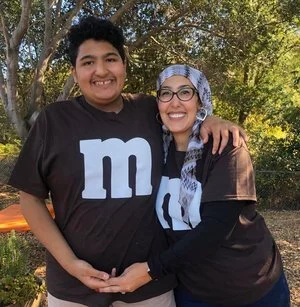
Oh Muhammed, or Mu, as we like to call him… my sun-shiny 13 year-old autistic boy, with his big smile, bigger hugs, and that mischievous sparkle in his eye. I’m literally kvelling just thinking about him. 

But the rest of the world? Its patience seems to be wearing thin. As I explained in a post last year, Inclusion Sucks, Or Why My Son Has Nowhere to Swim this Summer, Mu has the sort of autism that makes him welcome, well, not a whole lotta places. So naturally we’ve had another summer of rejection.

Here’s how it started. Mu can speak some sentences, though usually only when the planets and Ben & Jerry’s align, and even then he’s not understood by non-familiar listeners. Therefore he is considered functionally nonverbal. So to help him communicate he uses an Augmentative and Alternative Communication device (AAC). The AAC has been a godsend. It reduces his frustration and lets him bark at me like a regular teenager. His device shouts, “Want fries!" (his favorite vegetable) and “Want bubble water!” (In my experience, the word “please” drops from the English vocabulary between ages 13-17, autism or no.) 

And it’s not just about food. He can use it say, “Fix that!”— “that” being soap dispensers (three of them, yes, there must be three) when not placed at perfect 90-degree angles. Not to mention helping him medically, since he can usually use it to tell me where the “hurt” is. Mu wears the device pretty much all day long. It’s his voice, an essential. 

Now, Mu’s autism is really severe. He can be aggressive at times, have tantrums, and massive meltdowns. And when he does, you better believe the device is right there through it all. So our insurance policy includes getting a loaner during repairs. But recently the company that makes the device denied Mu one. Why? He was on the “Do Not Loan List.”

I mean I’m an Arab and a Muslim so I’ve totally heard of the Do Not Fly List. I’ve even heard of the Do Not Call List. But a Do Not Loan List? What’s the heck is that? Like a three-strikes law for autistic people?

"I'm an Arab and a Muslim so I've totally heard of the Do Not Fly List.... But the Do Not Loan List? What’s the heck is that? ​Like a three-strikes law for autistic people?"

I pleaded with the rep, telling him the AAC is his voice, not a vacuum cleaner! The rep still wouldn’t budge. Too many loans, and my son was Out.
 
Anyway, even without a loaner, Mu managed to ask to go swimming about 100 times. But guess what, we can’t go. Because, wouldn’t you know, we are also on the Do Not Swim List.
 
We recently took Mu to a nearby community pool, and let’s just say things didn't go so smoothly. We were asked to leave.

"Let's just say things didn't go so smoothly. We were asked to leave."

As soon as he blasted through the door, Mu jumped on, and broke, the pool’s handicap chair. Yes, you know that something that exists to make the pool more inclusive.

​I gotta admit… not cool Mu. That was way outta line and I laid it down to him. But believe it or not, that’s not why we were asked to leave. It’s because he was bothering the “moms and their young children” and taking “bites out of the swim noodles.” First off, I’m fairly certain there were chunks missing in the swim noodles when we got there—hey, it’s not like typically developing kids are all well behaved angels. And second, if allowed to return I would bring an armful of new ones as gifts—the Dollar Store is, after all, an autism mom’s best friend. But for now, it’s no AAC and no pool for Mu.
 
Now, I know what you are thinking—if Mu can’t behave in a way the public expects, at least there's help at home, right? 

Well, think again, because our behavioral agency recently put Mu on the Do Not Serve List.
 
After years of working with us they decided they wanted to drop Mu because they couldn't “appropriately” serve him (code for we don't get paid enough to deal with your kid). So, after much advocating we were able to secure help of another agency.
 
Then, within a week we faced another walkout. 

It started with the toilet. If something has a moving part, Mu will most certainly figure out a way to break it. It’s not that he means to or does it on purpose. He’s just very strong and doesn’t realize his own strength most of the time, some of the time, okay… all of the time. 

[Although I feel in a recent case he was plotting against me. Seriously, how did he even think to remove the toilet tank cover and stick in whole roll of toilet paper, then put the cover back on, and don’t even ask me what the plastic thing was in the middle of the roll. Again, not cool, Mu.]

Anyway he broke the toilet handle and tank so often our handyman finally insisted on installing a commercial version made of one solid piece.

Problem solved? Hardly, because then Mu broke off one of the sink handles, and then the doorknobs to the bathroom. Three strikes, again. ​​

Even the handyman had enough. He quit, too. Yes, the ultimate nightmare for us autism parents—the Do Not Fix List.

Inclusion is a hot topic in disability circles, but when our kids can’t play by society’s rules, inclusion can truly suck. Instead of some fantasy of joyful acceptance, we get black-listed. Over and over and over. How I dream of places, spaces and programs fully accepting of our special children. Autism-friendly rules, not “If you act autistic you’re out” rules.

 "Instead of some fantasy of joyful acceptance, we get black-listed."

With that in mind I end on a more positive note. At Autism Society San Francisco Bay Area’s Summer Pool Parties we make sure an autistic kid can be him or herself. Where they can chew on pool noodles, bellow and flop around, and no one judges them. ​So here we are, me in the burkini and Mu in his element. A place, however small, where everyone with autism belongs... on the VIP List. If only the rest of the world were so accommodating.

[End note. Please read before you send me hate mail. I believe all persons with autism should be accepted as they are anywhere they go, while I’m still holding out for my autism kibbutz or island. Whichever comes first. It’s all about choices. I respect everyone’s choices. Even yours.

And yes I’m a Muslim who likes to speak some Yiddish, okay? Kvell = to gaze upon with love and pride.​​

And finally, for those who don't like realities of autism discussed in public, I'm not shaming my son. There is no shame in behaviors one cannot control, it's like saying there's shame in a seizure for someone who has epilepsy. If you are ashamed for Mu, well shame on you.]

Feda Almaliti is Vice President of NCSA and Vice President of Autism Society San Francisco Bay Area.

Inclusion Sucks. Or, Why My Son with Severe Autism Has Nowhere to Swim this Summer

An autism mom stuck at home with her son on a hot summer day meditates
on the smallness of his world when inclusion is the only option.

Stock photo

Stock photo

By Feda Almaliti

It’s 95 degrees outside and I’m here at home with my little guy Muhammed. I call him my little guy because he is the youngest of my children, but little guy is 12 years old and already 5’10”. Muhammed has autism, the kind that most people don't like to talk about. He is constantly moving, vocalizing, and “fixing things” (because everybody knows that coffee mugs can only be on the left side of the middle shelf in the cupboard next to the sink, right?).

His language is limited but every other phrase is “want eat.” He is perpetually hungry, and did I mention he already weighs about 200 pounds? He finds solace in watching Dora videos, which he requests about 100 times a day. He grabs food at times when he’s not supposed to so we nicknamed him “Swiper the Fox,” but unlike the cartoon character he doesn't stop when we say “Swiper, No Swiping!” three times. He can charm the pants off you once you get to know him, and he is legit the coolest kid I know, and believe you me I know A LOT of kids ;).

Muhammed is never going to be a Sheldon or pass as a quirky kid with autism. He has his awesome days and the not so awesome ones where he’s a whirl of mental and physical chaos. But this boy has a calm and happy place, and it’s smack in the middle of a cool blue pool. But like most autism moms, I don't have a pool. I will not be blessed with a pool anytime soon unless some reality show takes pity and surprises me with an Extreme Backyard Makeover.

So, given the stifling weather and the long weekend day ahead, I desperately want to take him swimming, but where can I go? In theory we could hop to a public pool, Y, hotel, or friend’s house. But reality is hardly so accommodating. No matter how much we may opine that severely developmentally disabled people like Muhammed deserve equal access to the community (which they absolutely do!) invisible signs everywhere tell us to "Go away."

Let’s face it, when he’s having one of ‘dem days, people don’t want kids like Muhammed near their calm and carefully maintained pools and manicured gardens. He scares little kids. He scares adults. He might take off his bathing suit in public. He sometimes pees on the ground when we can’t get to the bathroom fast enough (it would be better if he did it in the pool like everyone else though, and don't pretend your kid doesn't). Sometimes he grabs strangers' food and eats or throws it. He annoys other pool-goers as he “sings” and yelps unintelligibly.

So, as you can imagine, we get evil stares. We are treated rudely or asked to leave. And he's not exactly invited back to my friends' pools. They are worried about "liability" or "disturbing the other tenants" or neighbors. Even my famous homemade hummus is not enough to persuade people to reopen their doors. So here we sit, dry-docked while the rest of the world frolics in the blue. Thank god at least we have air conditioning.
 
The idea of full inclusion is all too often an illusion for severely autistic people like Muhammed. Heck, if he attended a conference about autism discrimination he'd be kicked out in two minutes. So we should be alarmed by the rise of the militant inclusionista ideology that says no matter how profound their cognitive impairments or disruptive their behaviors, people like Muhammed should be included in the mainstream of community life at all times instead of "segregated" in special programs designed for them.

Segregated. Ouch, it sounds like such a horrible word. Brings to mind Jim Crow and whites-only drinking fountains.

But that's not what I'm talking about. I'm talking about self-imposed segregation …like nudist colonies, senior living facilities, women-only gyms or even smoking lounges in airports. Gosh, how I yearn for it. How desperately we need it! I literally have dreams of an autism island, but I'd totally settle for an autism kibbutz.

I imagine programs and places, away from the rules and consternation of the general community, where all of Muhammed's exuberance was welcome. Where he could be safe, and be totally himself, splashing and yelling to his heart's delight. This sort of positive segregation would open doors for Muhammed, instead of closing them.

"Heck, if he attended a conference about autism discrimination 
he'd be kicked out in two minutes."


Of course my pool predicament is a microcosm of a bigger problem: disability-friendly day programs, jobs, housing, and therapeutic care—vital lifelines for parts of our population—are at risk given the direction of federal policy. The trendy mantra is "community integration" while options for the severely disabled slowly disappear into the black hole of red tape and de-funding.

It’s not that I don't want my son to be included, to the contrary, we work with him at home every day, and let’s not forget the various therapists, aka uncanonized saints, to come closer and closer to that goal. But I’m a realist, and Muhammed will never live independently in the community and I’m never going to be the next Beyoncé. So, if inclusion is the only answer for Muhammed, his future will look like today: isolated inside our house, with nowhere to go.

"But I’m a realist, and Muhammed will never live independently in the community
and I’m never going to be the next Beyoncé."

They say, “Why maintain an autism day program when Joe could just go to the local Y?” or “Why have sheltered workshops when Sam can get a competitive job at Safeway?” Please tell me, what are these people smoking and in which smoking lounge can I find them? Have they ever tried caregiving for someone like my son? 

So let's make a deal. Let's ensure inclusion and integration for all those who want it. And let's support acceptance of all, including acceptance of alternative options for the Muhammeds of our world. Don't let narrow ideology throw our babies out with the bath, or, er, pool water. It's just common sense. In the meantime if you'll invite us over for a swim, we'd appreciate it.

(This is only MY opinion obviously but undoubtedly some people will misinterpret this piece to mean I believe that all people with autism should be segregated from the community, which I am not saying nor implying nor do I believe! But let the hate mail begin in 3, 2, 1….)

Feda Almaliti is an autism mother who lives in the San Francisco Bay Area.  This blogpost was reprinted based on the original 2017 post at Autism Society San Francisco Bay Area.

Coronavirus Crisis: NCSA's Feda Almaliti on NPR

THE CORONAVIRUS CRISIS

'He's Incredibly Confused': Parenting A Child With Autism During The Pandemic

almaliti-family_custom-09cdd39cdf2ebac0e6769d2739c2c27265414d07-s300-c85.jpg

Thank you to NPR’s All Things Considered for speaking with NCSA Vice President Feda Almaliti about how the stresses of the coronavirus crisis on families with severe autism.

———————————————

Living with the pandemic has been difficult for everyone: the isolation, the need to wear protective gear like masks and gloves, the adjustment to working or learning from home.

For those living with or caring for someone with severe autism, those challenges can be exponentially more difficult.

"Wearing gloves or masks, you know, things like that? That's just not going to happen here," says Feda Almaliti….. Hear the radio program on NPR here

CDC Study Estimates 2.2% of U.S. Adults Have Autism — Don’t Believe a Word of It

The paper’s adult autism numbers are wildly overblown, and worse than useless.

cdc.jpg

By Jill Escher

Autism research has long been something of a spectacle. For every study that actually moves the field forward, it seems a dozen are fairly worthless, same-old same-old, or totally bizarre.

But I never expected that work from our own U.S. Centers for Disease Control (CDC) would fall into that last category.

This week the Journal of Autism and Developmental Disorders published a paper, “National and State Estimates of Adults with Autism Spectrum Disorder,” by the CDC’s Patricia Dietz, Charles Rose, Dedria McArthur, and Matthew Maenner. The news sites blared across the internet: “First United States Study Of Autism In Adults Estimates 2.2% Have Autism Spectrum Disorder,” or “CDC Researchers: Over 5 Million US Adults Have Autism.”

But the study estimating a supposed 2.2% prevalence in adults, was, how can I put it mildly, utterly preposterous.

It was, in essence, nothing more than a glorified back-of-the-envelope type of exercise that did not actually look at any data pertaining to autistic adults. Rather, it used data for children with ASD and, adjusting for mortality rates, projected what adult rates might be based on current childhood rates.

The obvious flaw? The method was based on the fundamental assumption that the birth year autism prevalence is constant over all ages considered, going back to 84 years before 2017. Yep, they assumed autism rates were the same in 1933 as 2017, and all years in between.

Never mind that there’s not a shred of evidence for this — not in medical, academic, institutional, military, court, social security or any other records, whether pegged under autism or any other label. And never mind that the CDC itself has published numerous studies indicating increasing autism prevalence over successive birth years.

But apparently at the CDC it’s cool to ignore actual facts. So, simply assuming current rates apply to all ages, even 87 year-olds, the paper estimates that in 2017 the U.S. adult prevalence of autism was 2.21%, or 5,437,988 U.S. adults (!) aged 18–84 years. Five and a half million autistic adults? What? How? Where?  Anyone with eyes can see that’s just not true.

It also estimates the states with the greatest number of adults with ASD included California, at 701,669 cases, Texas with 449,631, New York, with 342,280, and Florida, with 329,131.

Validity check, anyone? These numbers are absurd on their face. For example, in California we obviously have nowhere near 701,669 cases of adult ASD.

Calif DDS Autism Birth Year.png

California is known for maintaining the country’s best records on autism in the population. In our Department of Developmental Services (DDS) there are currently about 39,000 cases of autism for ages 18 and up. Outside of DDS, which would include milder cases ineligible for developmental services, the population has been estimated to add about 30% more than that number, so perhaps we have about 50,000-60,000 total adult ASD cases. It boggles the mind that any researcher who knew anything about autism in the real world would estimate that California has 701,669 diagnosable adult ASD cases.

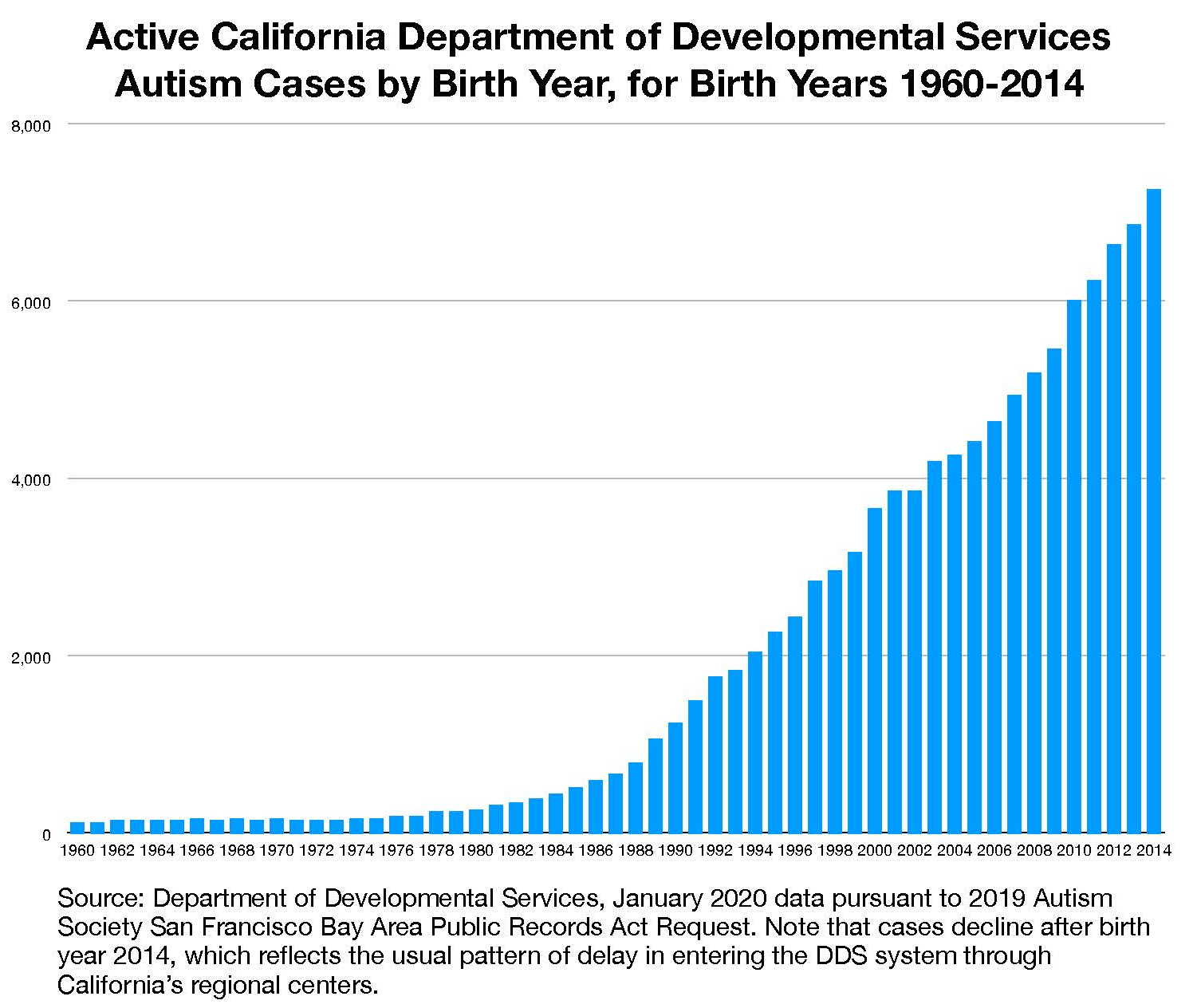
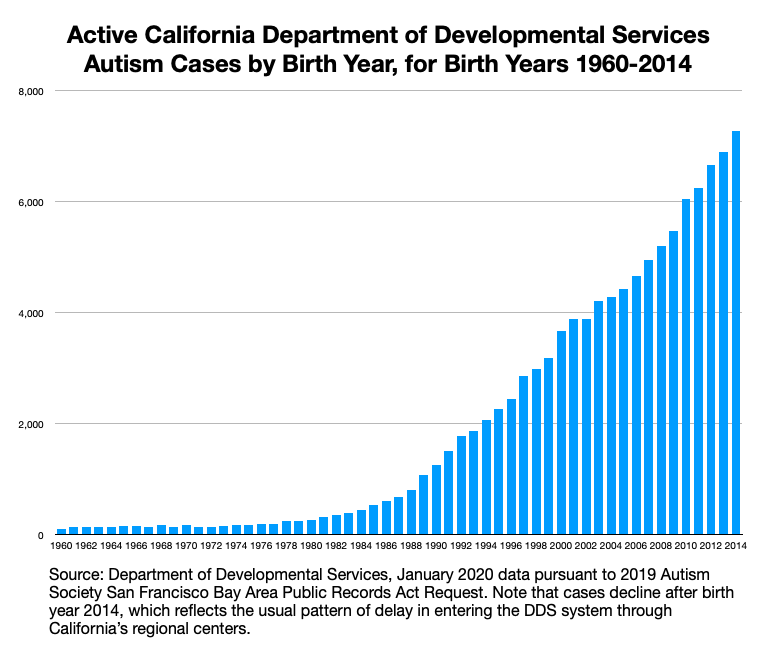
Moreover, California has kept close tabs on autism for many decades. And what does that data say about autism by birth year? That the rates have skyrocketed beginning with births in the early 1980s, something even the California Department of Public Health has verified in prevalence studies. The graph to the left shows the DDS autism cases by birth year: about 200 per year through the early 1980s to more than 7,200 by 2014. In other words, real-world data show unequivocally a massive upsurge in cases over time.

In fact, DDS data show there are only 4,000 developmental disability-qualifying autistic adults born before 1980 in the entire state. If rates remained constant over time, as the CDC suggests is the case, the state would have about 250,000 such adults instead of the actual 4,000. But there’s not a shred of evidence our robust system has missed even a tiny fraction of the supposed 246,000 missed cases.

So, how did this new CDC paper get away with such absurdities?

The authors say they assume ASD prevalence among children and adults (of all ages) is similar because there is no evidence that environmental factors associated with ASD have changed over time. They say “few risk factors have consistently been associated with ASD and those that have been identified have accounted for a very small percent of increases in diagnosed ASD.”

Actually, they are correct, to a point. With rare exceptions (like fetal exposure to anti-seizure medication and prematurity), exposures investigated to date (and this includes vaccines, which obviously do not cause the dysregulated brain development of autism) cannot explain the colossal increases in autism witnessed across our country.

But — and I can’t believe this needs stating — it makes no sense to dismiss an increase by birth year simply because you don’t know what caused it. That’s like saying that people were not getting sick and dying of Covid-19 if we didn’t know what caused it. Or children were always born with high rates of microcephaly because we didn’t know about Zika. 

Epidemiology works the other way around, of course. First you identify changes in disease incidence, which for disorders like autism means birth year prevalence, and you use that information as a clue as to causes. The CDC’s role is to identify risk factors driving pathologies afflicting Americans. But in a move that should outrage anyone who cares about autism, it is now waving the white flag of scientific surrender, saying basically, “We don’t know what is causing this autism increase and we assume there’s nothing more to discover.” An abdication of its core responsibility to the U.S. people.

In the good news department, it seems this paper had some noble intentions. “National and state-based estimates of adults living with ASD could inform planning for programs,” say the authors. And yes, we desperately need policymakers to understand the prevalence and number of cases so we can support the legions of disabled adults. But this study offers nothing of value, and, worse, signals an alarming level of apathy about causation of very serious neurodevelopmental pathology that has flooded our communities.

Jill Escher is founder of the Escher Fund for Autism, which promotes research in the genetic toxicology of autism, GermlineExposures.org. She is also President of the National Council on Severe Autism and Immediate Past President of Autism Society San Francisco Bay Area.

Disclaimer: All blogposts on NCSA represent the views of the authors and are not necessarily the views of NCSA.