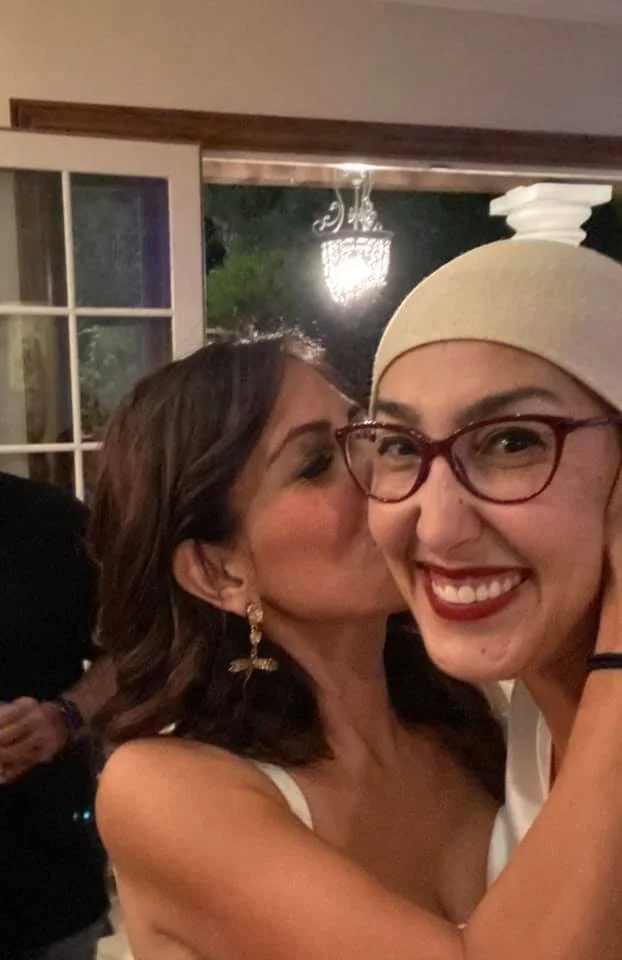
#There’sNoOneLikeFeda

NCSA President Jill Escher shares some personal reminiscences about her colleague and friend Feda Almaliti, the NCSA co-founder and Vice President who tragically died with her beloved autistic son Muhammed on September 26 (see our tribute here).

“These vignettes provide just a glimpse into Feda’s colorful personality,” says Escher. “They are not meant to explain the arc of her advocacy work, just some stories to allow her unique humor and spirit to shine on a bit longer.”

#It’sAGift

Scenes from autism conferences Feda helped to organize.

Scenes from autism conferences Feda helped to organize.

As much as Feda adored Mu, she had no illusions about the seriousness of his condition, and would often ridicule the neurodiversity celebration of autism with her ironic hashtag #ItsAGift

After our friend’s autistic son bashed his head into a bloody pulp Feda would text #ItsAGift. When Mu would leave a bruise on her leg the size of a grapefruit, she'd roll her eyes and say #ItsAGift. When my son shredded my car’s interior, I knew what hashtag was coming.

But perhaps autism WAS a gift to Feda in a certain respect. It was a boundary-breaker that pushed her into a limitless world of people and purpose. Married at 17, with a first son at 18, and without even a high school diploma, Feda perhaps had a fairly constrained life, but one with brilliance and creative energy brimming inside. Autism was like her Big Bang, and she was grateful for it. She once quipped, “Before autism, the highlight of my week was reading the circular from Macy’s.”

Perfect Black

Screen Shot 2020-10-06 at 7.47.47 PM.png

Feda rejected political correctness. With her genuine love for people of all backgrounds (including Jews like me), she knew the glue that held people together was humor, the ability to poke fun — based on a foundation of genuine respect, and not some eggshell-walking fear of offending.

Potty-mouthed Feda was an equal opportunity offender. One night she took me and our dear friend Mawuko (whom she had nicknamed "Perfect Black") out to see a Black standup comic who delivered 45 minutes of nonstop sexually and racially offensive drivel. Well I thought it was drivel but Feda laughed hysterically the entire time.

Her cross-cultural affections, though, were a serious matter. Less than a week before she died she told us about a handsome, successful Muslim man she was online dating. But then, she said, on Facebook she posted a big "Shana Tova!" meme for Jewish New Year. The guy saw it and reprimanded Feda, saying he could never lay his hands on a woman who befriended Jews. Disgusted, she dropped him like a hot potato, or knish.

She and I used to joke that together, having experienced the common bonds of humanity through our lives with severe autism, we could create peace in the Middle East.

sweater.jpg
IMG_3541.jpg

Even in a hijab or headscarf, Feda could rock an Ugly Christmas Sweater. She played Santa Claus at a special autism family holiday concert at Stanford. Her bestie “soul sister” Alicia was a devout Catholic.

She considered most supposed differences merely superficial, and made fun of absolutely everyone, even herself. After I asked that attendees at a gathering called “Autism On Tap” wear nametags, Feda showed up with hers saying, “TOKEN MUSLIM.”

Her perfect world would have been a blend of aromatic Palestinian cuisine (at which she was a master), Curb Your Enthusiasm and RuPaul’s Drag Race. She lovingly called an adorable and flamboyant young man who worked with her son Mu “My Gay.” I think she wanted her world spiced with every color of the human rainbow.

Feda was just completely authentic, completely curious, and had little patience for social niceties. One day we went out for a lunch with an elderly, genteel friend in her 80s. After our friend showed us pictures of her boyfriend, Feda blurted, "You have to tell me, DO YOU GUYS HAVE SEX?”

Ah how you will be missed, #Towelhead.

The Supreme Leader

Screen Shot 2020-10-06 at 7.47.32 PM.png

Being Autism Society San Francisco Bay Area President to Feda's VP meant enduring years of mockery, including being called "THE SUPREME LEADER KIM JONG JILL.” (Okay, I suppose I could be a little bossy at times….)
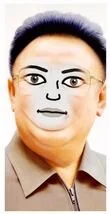
Feda’s rendering of  “Supreme Leader Kim Jong Jill.”

Feda’s rendering of “Supreme Leader Kim Jong Jill.”

One time she invited people to an SFASA pre-conference dinner as such:

"Comrades, You are hear-by ordered BEFORE November 7, 2018 to report your attendance status to the Ministry of Unification. Those who fail to do so by that date shall be summarily executed for defying an order from our Eternal General. 
—Feda Almaliti, Unworthy Servant of the Leader of Our Party Long Live Kim Jong Jill. 

Warning: The placement of this official email in any “Trash,” “Junk,” or “Spam” folder is punishable by the removal of a thumb.”

Oh What a Feeling

From Feda’s Facebook feed.

From Feda’s Facebook feed.

Three years ago Feda and I flew to San Diego for the Autism Law Summit, an event that was to close with a talent show. Happy to skip out on some of the sessions I trudged to a nearby Goodwill to find a baggy sweatshirt she would slash into a costume for a Flashdance "What a Feeling" routine. 

Besides the attire, there were two props, a chair (of course) and a big cup of water, that I, hidden just offstage, was to splash on her face at the very moment she struck her final pose.

Unfortunately I was laughing so uncontrollably during her routine (as was the entire audience) I completely forgot to throw the water, so there she was legs astride the chair, her back arched, yelling "water!"

As we got off the stage she rolled her eyes in disbelief, saying, "YOU HAD JUST ONE JOB!" 

“Gel or Acrylic?”

Screen Shot 2020-10-06 at 7.48.23 PM.png

Manicures were not my thing but Feda knew that autism moms needed a break whether they admitted it or not. So when Feda said “Bitch, we’re getting our nails done!” you went and you loved every second. 

Science Freak. Not.
Screen Shot 2020-10-06 at 7.48.36 PM.png

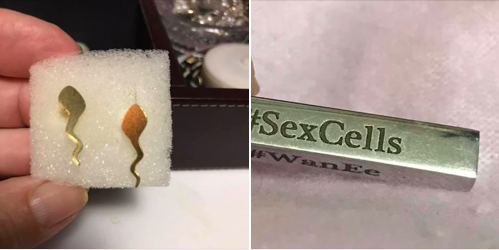
Feda had no great love for science but was humorously supportive of my autism research work, which she nicknamed the #FuckedEggs Hypothesis of Autism (actually, mostly accurate).

You have to hand it to her. To me it's the "Germline Toxicant Exposure and Dysregulated Transcription of Brain Development Genes" hypothesis and hers was just plain old, direct #FuckedEggs. Hers was better, an A+ to my B-.

She gifted me many trinkets along this theme. A DNA scarf, sperm earrings, sperm necklace, and a #SexCells pendant among them. She said #SexCells, which was of course a play on the words “Sex Sells,” would be the name of my book about #FuckedEggs and sperm. She gave me permission to use her and Mu’s likeness and story in many scientific presentations. 

I am #ForeverGrateful.

Bringing the Mountain to Muhammed
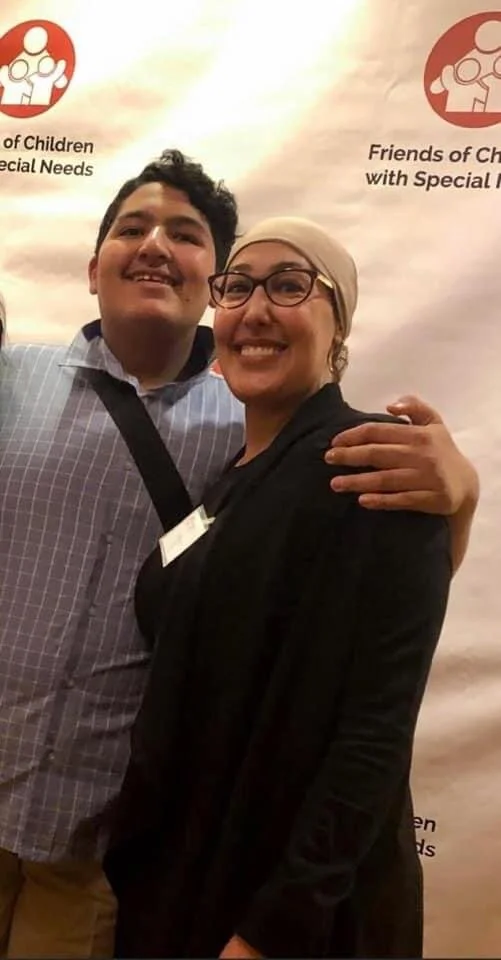
Mu and Feda at a fundraiser earlier this year.

Mu and Feda at a fundraiser earlier this year.

Feda was just an awesome mom. She worked tirelessly for Mu and gave him his best life. But at several junctures I felt it was simply not safe for Mu to live with her; he was huge, strong and willful, and too often damaged the home or (inadvertently) hurt her. When I suggested she have him placed in professional care, she resisted. Instead she would “move the mountain to Muhammed” so to speak, and after much advocating boosted the array of services for him at home. She succeeded to an extent, but was left alone at night. And that was not enough to save him, or her.

Feda made this video earlier this year about Mu’s “Dope Life.” Enjoy.

Get to know Feda: Here she is being interviewed by her friend and colleague Sarah Trautman. You can watch it here.

Get to know Feda: Here she is being interviewed by her friend and colleague Sarah Trautman. You can watch it here.

Feda wanted to make the autism world a happier place, and she succeeded with her own son, her local community (too many SFASA activities to count), her state (helping pass insurance reform), and the country (as a national advocate for severe autism). She had so very much to offer, and will be greatly missed.

Jill Escher is the President of the National Council on Severe Autism and Immediate Past President of Autism Society San Francisco Bay Area. She is also an autism research philanthropist, through the Escher Fund for Autism.

Ways to honor and remember Feda and Muhammed here

Ways to Honor the Late Feda Almaliti and Her Son Muhammed

Remembering and Honoring Feda and Mu

IMG_0434.jpg

[Event and virtual event information to be posted soon]

Address for letters and other mail:

Salah Family
1141 Apple Ave
Hayward, CA 94541

Post your respects, memories, and photos online on Forever Missed:
https://www.forevermissed.com/feda-mu/about

Donations:
We know that Feda would have appreciated donations to any of the following in her and Mu's honor.

National Council on Severe Autism
Feda was so proud to have been a founding board member of the NCSA. She was devoted to bringing the realities of severe autism to light, to help forge desperately needed advances in programs, care and national policy.
https://www.ncsautism.org/donate

Autism Society San Francisco Bay Area
As Vice President of SFASA, Feda loved creating local events to help her fellow autism families. These included the SFASA Pool Parties, Autism on Tap series, and of course the annual conferences. Feda Fund donations will be used toward creating future events Feda would have loved.
https://www.sfautismsociety.org/donate.html

Autism Law Summit (Feda Almaliti Scholarship Fund)
Feda had hundreds of autism friends around the country whom she knew because of the annual Autism Law Summit. Feda wowed the audience at the 2018 Summit with a luncheon keynote that had everyone laughing and crying at once. In her honor, the Autism Law Summit has established the Feda Almaliti Scholarship Fund to bless one or more parent advocates with a scholarship to attend the Summit.
https://www.paypal.com/paypalme/fedascholarshipfund

Autism Mental Health Insurance Project
Feda got her start in autism advocacy by fearlessly pushing for insurance reform in California, to expand access to behavioral health treatments for all affected by autism. Your donations will go towards a scholarship fund to assist low income families with advocacy services. Feda served on the board of directors and helped to guide its vision from 2013 until her death.  
www.mhautism.org

Hear and see other remembrances of Feda and Mu:

National Public Radio'sAll Things Considered here

NCSA Facebook Page

Autism Science Foundation Podcast here(by Alycia Halladay)

East Bay Times here

CBS San Francisco here

NBC Bay Area here

Daily Mail (UK) here

Censoring autism: We must resist the crusade to quash severe disability

No one questions putting Greta Thunberg’s autism in the limelight. It must be the same for all forms of autism, writes Tom Clements.

High functioning autism, represented here by Greta Thunberg, and low functioning autism, represented by the author’s brother Jack, both deserve places in the public consciousness. “For all practical purposes, these manifest as two completely distinc…

High functioning autism, represented here by Greta Thunberg, and low functioning autism, represented by the author’s brother Jack, both deserve places in the public consciousness. “For all practical purposes, these manifest as two completely distinct conditions, despite the ‘autism’ label".”

By Tom Clements

Autism, like any disability, varies considerably in its severity. Whilst some people have visual impairment, for example, others are completely blind. But as certain sections of the advocacy community reject the descriptors of “mild” and “severe” autism as overly medicalising and discriminatory, the vast majority of us acknowledge that distinctions between higher and lower levels of impairment are simply a reflection of reality. Of course, that’s not to say that such descriptors convey the entire truth of an autistic individual’s experience and nor does it mean that those with mild autism necessarily have an easier time of it. In fact, in certain respects those with mild autism often suffer to a greater degree psychologically, not least because they often possess far greater insight into their condition and are more intensely aware of haunting feelings of loneliness and inadequacy. 

Nevertheless, the characteristics can be like polar opposites: a highly articulate and strategic Aspie like Greta Thunberg on one hand, and those who can barely utter a single word or attend to their basic needs, like my younger brother Jack, on the other. For all practical purposes, these manifest as two completely distinct conditions, despite the “autism” label.

The recent drive by neurodiversity advocates to discard functioning labels has led to some absurdly counterfactual statements by certain self-advocates about the nature of autism itself. The refrain that “all autistic people are equally autistic” is often repeated nowadays on social media, despite of course being demonstrably untrue. San Francisco-based advocate John Marble, a prominent neurodiversity proponent and erstwhile advisor to Barack Obama, even went so far as to say in a now infamous tweet that “THERE’S NO SUCH THING AS SEVERE AUTISM, just as there’s no such thing as ‘severe homosexuality’ or ‘severe blackness.’” 

Yes, the notion that all human life is of equal worth is, and must remain, the foundational principle of our civilisation as underpinned by Western Englightenment values. However, it is biology and not “systemic ableism” or some other external bogeyman that gives birth to the endless inequalities of functional outcomes we see among human beings. To admit that some people are less capable or intelligent than others might not be to everyone’s taste, but functional inequality is an obvious, conspicuous truth, particularly in autism. 

To deny (severe autism) is potentially very dangerous as it paints a false image of the condition that could lead to policymaking that is counterproductive to the needs of the severely affected.

To deny this, regardless of whether the intentions behind such a denial are good or bad, is potentially very dangerous as it paints a false image of the condition that could lead to policymaking that is counterproductive to the needs of the severely affected. One such belief, championed by the likes of the Autistic Self-Advocacy Network, is that all autistic people, even those with substantial cognitive and verbal impairment, fare better when treated as “merely different” and thus not in need of specialized forms of housing, supervision, employment and day activities. Conflicts with neighbours, susceptibility to elopement and an unhealthy absence of structure and supervision naturally renders such a prospect terrifying to many parents of children and adult-children on the severe end of the spectrum. Ignoring the vast gulf between mildly autistic people capable of independent living and severely autistic people who are heavily reliant on others, and often possessed of dangerous and disruptive behaviours, threatens the latter with virtual abandonment.

The crusade to abolish pathologising terms from autism discourse coincides with the more recent drive to censor video evidence of severe autism. For example, a petition started 3 months ago calling for YouTube to ban videos of autistic children’s meltdowns is close to garnering 100,000 signatures thanks to a sustained campaign by neurodiversity activists to frame such videos as “abuse.” But contrary to the shrill hyperbole of activists, such videos aim not to “humiliate” or “abuse” kids, but to show just how devastating severe autism can be; they are often posted out of desperation as a last resort, an anguished cry for community awareness and assistance. 

Whilst our media is saturated with mawkish portrayals of mildly autistic eccentrics, the harsh realities of severe autism are practically non-existent, save perhaps for the occasional documentary made by independent film-maker or journalist (Louis Theroux’s “Extreme Love: Autism” is especially good). Activists must stop being squeamish about severe autism. To erase the videos would in a sense equate to a kind of erasure of severely autistic individuals, the vast majority of whom cannot tell their story or communicate their suffering without the assistance of a parent or family member advocating for their needs. The anti-video petition is nothing less than an attempt to render an entire segment of autism practically invisible to the wider society.

Functioning labels are valid, public awareness of severe autism is valid, and no amount of fantasy-fueled histrionics can change that. Indeed, given the ever-mounting global autism crisis, these distinctions and stories warrant even greater emphasis.

Tom Clements is a British autistic writer. He is the author of The Autistic Buddha and The Autistic Brothers.


Disclaimer: Blogposts on the NCSA blog represent the opinions of the individual authors and not necessarily the views or positions of the NCSA or its board of directors.

Confessions of an autism father: a seesaw of despair and hope

The father of an autistic boy with severe behaviors who needs 24/7 care moves from paralyzing fear toward a sense of purpose

The author’s son Wyatt, right, with his two brothers.

The author’s son Wyatt, right, with his two brothers.

By Joshua Trainum

People would always ask me what exactly is our nine year-old son Wyatt’s condition. I would list a bunch of symptoms: non verbal, sensory-seeking, wears a diaper, self-harming, destructive with OCD tendencies. The easiest definition is low functioning autistic, but severely intellectually disabled certainly applies too.

My family has had an interesting 10 years. When Mariel was pregnant with the twins we knew from day one that there was something wrong with the baby B. He was small — twins are high risk but at our first appointment at seven weeks we were informed that something was not quite right but he could catch up. A few weeks went by and I had hope, you have such great hope for your children when you find out you are about to be a parent. I had hope when he was trending smaller in utero, I had hope when we were at the maternal and fetal medicine specialist getting sonograms twice a week. I had hope when they told us that baby B had stopped growing and the cord blood was reversing and we had to make a life and death decision. I had hope when Wyatt came out of the room at two pounds looking like a malnourished baby bird. 

We decided on the name Wyatt after much deliberation because it meant little warrior. He was our little warrior. We had hope when we took Zeke home from the hospital after 18 days and had to leave Wyatt in there to fight and grow for another 2 months. I had hope that when he took to the bottle and got off the feeding tube and started gaining weight. I had hope when at five pounds we could take him home from the NICU and we had the first night all together. I had hope that we wouldn’t get such little sleep the first year because the twins were on different sleeping schedules.

He was around two when he started not looking us in the eye and just suddenly stopped meeting milestones. I knew then it was serious but I had hope when his body had a limitless desire to find stimulation that we may find help. Around three he got so big he was able to crawl out of the crib; this is when the years of sleepless nights began. Wyatt would jump and stim in our bed for hours. We used to try to get him down by laying next to his crib and rubbing him for hours so he would fall asleep. I actually think we were on mattresses on the floor because he had jumped so much he broke his crib apart. This is probably the first piece of furniture I remember him breaking, but it would not be last. We suffered many sleepless nights and I was grateful to be able to travel for work. I got to escape by going to work. There is so much more to say but my amazing partner is an absolute saint. 

The Trainum family.

The Trainum family.

This is about the time I lost hope…. I knew Wyatt would be a lifelong responsibility, but when explaining our situation people would always say don’t worry they will be able to figure something out. I would probably have said the same thing before Wyatt. The fear, bitterness, anger is paralyzing. I don't know how to explain it, but it was eating me up from the inside very slowly. We had a new baby by now, and the grace of my partner and foresight to insist this was the best for my family was probably what saved us. Baby Gabe and his relationship with Zeke and how both of them are the sweetest boys is probably the sole reason I did not go down a dark path. 

I was having troubles at work, I was angry and that anger and bitterness spilled over in other areas of my life. The task of getting Wyatt to have even a tiny chance of something just a little better seemed like an impossible task. We could sacrifice the well-being of our other children and pour every resource into private care for Wyatt, but to what end.

We live in an age where technology was available to save Wyatt’s life but where it fails to help him over the long term. 

Despite all this, I believe I am up to the task of being a better advocate for my baby Wyatt. I love him even though sometimes he is the absolute most draining thing. We all have fires to walk through. But we can all find purpose through the pain. There comes a time in your life when you confront a reality that is so unacceptable it leaves a scar on your soul. That scar is painful, but it has forced me to confront my story and face it without fear. This has been a turning point in my life, from struggle to peace, purpose, and strength. With purpose comes vision, with vision comes community, and with community comes empowerment.  

Joshua Trainum is the father of three boys. He lives in Florida.

A Renowned Physician Calls On Media to Acknowledge Autism's Brutal Truths

The profound impairments of autism are also "fit to print,” and acknowledging them is a crucial matter for public policy, writes Lee Wachtel, MD.

Kennedy Krieger Institute’s Neurobehavioral Unit serves patients with autism and other developmental disabilities.

Kennedy Krieger Institute’s Neurobehavioral Unit serves patients with autism and other developmental disabilities.

By Lee Elizabeth Wachtel, MD

Two mothers of autistic children whose stories were recently in The New York Times bring to the forefront an ideological battle that has been escalating for years in the world of autism.  We could call it Disability versus Diversity. Disorder versus Gift. Change-worthy versus celebration-worthy. It is true that autism is recognized clinically as a spectrum. Yet the capacity for our society to consider different perspectives within that spectrum is incongruously limited. 

The New York Times published the 2020 party line: we only learn and grow from autism, and a pox upon anyone who suggests that some aspects of autism are not laudable. I am not an autism parent, but I have led for the past 17 years an inpatient hospital service given over to autism and other developmental disorders. I would agree 110% that autistic children and their families are very special, and I readily confirm that their contributions to our world are spectacular. But I also bear witness to the brutal truth of the profound psychiatric, behavioral, cognitive and medical challenges that afflict some individuals with autism. 

And yes, afflict is the correct word, because when an autistic child has permanently blinded himself from self-injury, broken his teacher’s arm or swallowed multiple toothbrushes and required emergency surgery, there is nothing perfect or magnificent about it, and it must be remedied. One of the mothers writing in The New York Times readily recognized that her autistic son’s seizures were problematic rather than perfect and sought treatment. If you don’t believe me that many autistic children need and deserve treatment and related care, ask the mother who wanted a professionally-painted scleral shell for Mother’s Day so her daughter wouldn’t appear so disfigured after losing an eye to self-injury. Or the mother who lay in an ICU bed and held her dying autistic son after a brutal beating in a totally inappropriate setting. 

Children with autism will spend far more years as adults with autism, and the needs of some of those individuals will remain at very high levels of intensity across the lifespan. Those citizens, and their families, merit just as much attention and care as the autistic youngsters at the other end of the spectrum who typically have fewer cognitive, psychiatric and behavioral comorbidities, and may very well be capable of using their unique autistic mind as a “superpower” to solve Fermat’s Last Theorem or win a Nobel Prize. This is a crucial matter of public policy in our country, and we cannot afford to cater solely to one group’s agenda.

Sadly, American society has recently deteriorated into a cataclysmic “cancel” culture where anyone who dares to voice an alternate opinion – particularly one that is unpopular, points out fragilities or challenges the party line – is publicly shamed and ridiculed, and erased from the agenda. This is blatantly apparent in the world of autism and developmental disability, where if it isn’t a perfect or magnificent gift, we don’t want to hear about it, and certainly don’t want to address it or consider change, even when lives are at stake. While we haven’t yet exiled the autism dissenters to the gulag, the consequences of cancellation have banished the honest needs and plight of some to the figurative taiga, leaving the most vulnerable in precarious positions. 

We honor the 30th anniversary of the Americans with Disabilities Act during an unprecedented struggle against both COVID-19 and social injustice in our country. 

Let’s be brave, and not leave anyone out.

Lee Elizabeth Wachtel, MD is the Medical Director of the Neurobehavioral Unit at the Kennedy Krieger Institute and an Associate Professor of Psychiatry at the Johns Hopkins School of Medicine.

Disclaimer: Blogposts on the NCSA blog represent the opinions of the individual authors and not necessarily the views or positions of the NCSA or its board of directors.

"Illness is a social construct, the medicalisation of human diversity": A parody


Titania McGrath is a parody account on Twitter written by British comedian Andrew Doyle. Today “Titania’s” tweets stab right into themes seen in the baffling movement to normalize autism, take it out of the “medical model,” and render is a mere neurodiversity. We appreciate the dripping sarcasm and good laugh, Titania!

Screen Shot 2020-08-12 at 10.53.53 AM.png

@TitaniaMcGrath Activist. Healer. Radical intersectionalist poet. Selfless and brave. Buy my books.

Aug. 12, 2020

MEDICAL SCIENCE IS OPPRESSIVE: IT MUST BE BANNED (thread) For too long, so-called “doctors” have bullied and dehumanised those who do not conform to their perceptions of “wellness”. They have tried to “fix” those with non-healthy identities via “treatment”. No more.

[1 of 11] What we call “illness” is a social construct, defined negatively against its antithesis “wellness”. Society, in other words, has created the category of “illness” as a means to impose power on those who do not subscribe to cultural norms of what it means to be “well”.

[2 of 11] “Health” and “wellness” are mere taxonomies of privilege, inculcated by the hegemonic and oppressive discourses of “medical science”. Referring to someone as “well” or “ill”, “healthy” or “unhealthy”, is simply the medicalisation of human diversity.

[3 of 11] The hierarchical dichotomy of “well” and “ill” are co-constituting, each one creating the other through a process of performativity. Moreover, science is an irredeemably white, patriarchal, cisnormative fiction that exists only to disempower marginalised identities.

[4 of 11] Just as heterosexism posits the supremacy of heterosexuality to queerness, healthism situates wellness as the default experience of humanity in order to stigmatise illness as inherently deviant.

[5 of 11] These assumptions deny the performative nature of illness and wellness towards a neoliberal goal: individual autonomy as a means to secure labour (i.e., a “healthy workforce”) for the benefit of the capitalist system.

[6 of 11] In order to dismantle oppressive medical power structures, we must do the following: • Close all hospitals, surgeries, clinics, and any other institutions that perpetuate healthism.• Destroy all medical textbooks and uplift non-scientific ways of knowing.

[7 of 11] • Reject all forms of science as white heteropatriarchal queerantagonistic constructs. • Ban the study of all branches of medicine (anatomy, biochemistry, endocrinology, genetics, immunology, neuroscience, pharmacology, etc).

Rebuke those who claim to be ‘in need of medical attention’ as identity-traitors.

[8 of 11] • Re-educate children to embrace and celebrate illness rather than seeking a “cure”. If a child is “diagnosed” with a “disease”, this narrative must be countered by teaching them to actively engage in disrupting the cultural norms of “wellness” and “illness”.

[9 of 11] • Rebuke those who claim to be “in need of medical attention” as identity-traitors. (Such internalised healthism is a form of complicity with systemic medicalisation.)

[10 of 11] • Resist the oppression of healthnormativity in everyday language. Criminalise pleasantries such as “How are you?” and “Are you well?” • Stop taking aspirin. FIN.

[11 of 11] You can follow @TitaniaMcGrath. (Source: https://threader.app/thread/1293556090895032322)

"I cannot survive the endless aggression"

When autism parents are attacked in their own homes, constant 911 calls are not enough

Stock photo

Stock photo

By Ellen N

I am a single mom in desperate straits. Last month I had to take my 18 year-old severely autistic son, I’ll call him K, to the ER due to his violence against himself and me. They almost sent him home like they have in the past, until he had a meltdown. Then it took 10 staff members to restrain him while giving 2 shots of Ativan and getting 2 sets of adult restraints on him to keep him and everyone else safe. It took about an hour and a half for the Ativan to kick in and calm him.

It is no longer safe to have him home—either for him or for me. He stayed in the ER until an emergency respite house could be found that would take him while we await residential placement. He has been in the respite house since mid-month. This is helpful — but I only have three weeks and then he is released back to my care. 

I received a call from his case manager at the Office for Persons with Developmental Disabilities (OPWDD) stating that he had a meeting with a committee to get K into residential placement, and he was listed as a Level 1 priority, which means he is at the top of the list. This seemed helpful, but then he said he does not know how long it will take to find him a spot and he doesn't know how the process works or who actually does it. I still have not heard anything about a potential residential placement.

When I asked him what am I supposed to do to keep us both safe at home if there is no residential placement, he tells me to do what I did before, which was to call 911 and hope the responders take him to the ER again. Which is basically the same as saying “We will do nothing to help you.”

Last time I had to call 911 three times in two days before anything was done. The first time K was calm when they arrived so nothing was done. The second time the officer watched him hit me but claimed he was not a threat so wouldn't do anything. Finally after the third call an officer agreed there was a threat to K’s and my safety, so he took us to the ER. Luckily this officer saw the damage done to me and my car when he attacked me while we were driving back in March. So he knew what would happen if things weren't done to protect us both.

I had to have X-rays on my back and shoulder from the hits I took every day for the last year or so and do not have the results back yet, but know there is damage. And I fear what will come next.

Meanwhile, K’s doctor left the practice where he is a patient. So while all of this is going on, we had to go through an emergency process to fill his medications.

Last time I visited K he flipped out when he saw me and wanted to come home but couldn’t. He had to be sedated again, and since staff and I don't want him to go through that again we decided it was best for me not to see him while he is there. I call them every morning and night to see how he is doing.

This has been hell for us but I am also terrified of what could happen to me if he has to come home. 

To make matters worse, I have not been able to work for over 10 years due to having to be home with K. I just sold our house and was planning on renting but since I don't have a recent work history, and no real credit because of his SSI being our only income for so long, etc., it is hard finding a place.

I am so frustrated. I never wanted to have to place him somewhere else so it kills me that I now have to for both of our safety. But I also, literally, cannot survive the endless aggression. I have no help from family or friends. Even the people who are supposed to help don't help.

Ellen N is the pseudonym of a mother of a severely autistic young man who lives in New York State.