Commentary: A full semantic toolbox is essential for autism research and practice to thrive
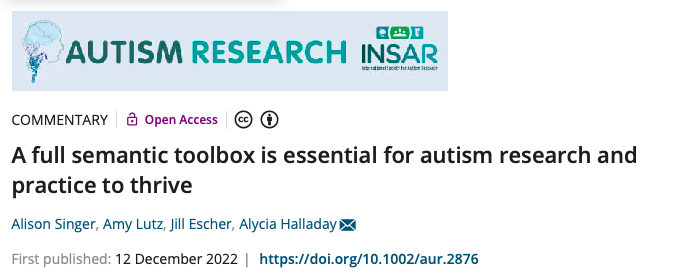
A new commentary published in the journal Autism Research, the journal of the International Society for Autism Research, counters the call by several neurodiversity advocates to limit language and terms relating to autism. Three of the authors serve on the NCSA board: Alison Singer, Amy Lutz and Jill Escher.
Read it here
Abstract
Individuals diagnosed with autism spectrum disorder (ASD) present with a highly diverse set of challenges, disabilities, impairments and strengths. Recently, it has been suggested that researchers and practitioners avoid using certain words to describe the difficulties and impairments experienced by individuals with ASD to reduce stigma. The proposed limitations on terminology were developed by only a subset of the autism community, and the recommendations are already causing negative consequences that may be harmful to future scientific and clinical endeavors and, ultimately, to people with ASD. No one should have the power to censor language to exclude the observable realities of autism. Scientists and clinicians must be able to use any scientifically accurate terms necessary to describe the wide range of autistic people they study and support, without fear of censure or retribution.
Authors:
Alison Singer, Autism Science Foundation
Amy Lutz, PhD, History and Sociology of Science, University of Pennsylvania
Jill Escher, National Council on Severe Autism
Alycia Halladay, PhD, Department of Pharmacology and Toxicology, Rutgers University