
ADA at 35 (1990-2025): Recommitting to Equity for People with Severe Autism
By Jackie Kancir, NCSA Executive Director
____________________________________
Today, we mark the 35th anniversary of the Americans with Disabilities Act (ADA), a groundbreaking civil rights law intended to ensure that people with disabilities have the same rights and opportunities as everyone else. Nevertheless, 35 years later, for the surging population of individuals with severe autism, the full promise of the ADA remains painfully out of reach.
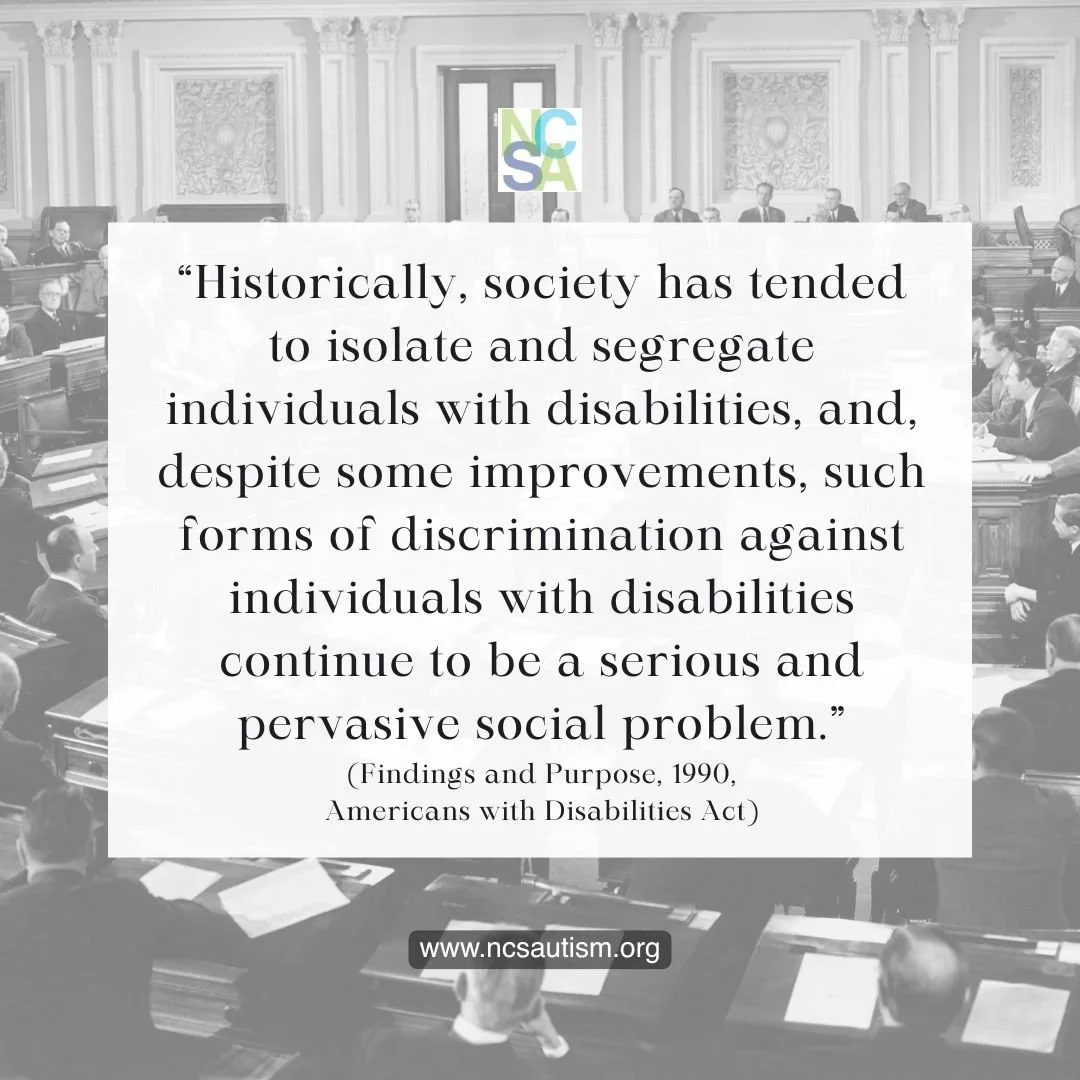
In 1990, Congress acknowledged that “individuals with disabilities continually encounter various forms of discrimination, including outright intentional exclusion, the discriminatory effects of architectural, transportation, and communication barriers, overprotective rules and policies, failure to make modifications to existing facilities and practices, exclusionary qualification standards and criteria, segregation, and relegation to lesser services, programs, activities, benefits, jobs, or other opportunities.”
Over three decades later, these injustices still define daily life for too many people with severe autism.
A Legacy Still Waiting to Be Fulfilled
Since the ADA’s passage, there have been meaningful gains worth celebrating, such as greater public awareness, improved access to schools, and the expanded use of assistive technology. The law requires that businesses and public entities provide reasonable accommodations, including behavioral supports and service animals. As a result, families have been able to enjoy sensory-friendly movie screenings, expedited entry at theme parks, and the reassurance of bringing a service dog to public places like malls. The ADA has also made it possible for caregivers to remain with their loved ones during hospital stays and medical appointments, providing essential communication support and continuity of care.
Yet, many benefits of the ADA are often inaccessible to the very individuals who need them most. The wins from the ADA have disproportionately benefited individuals with near-average to above-average intelligence, functional communication, and manageable behaviors.
For those with severe autism who have significant cognitive and functional impairment, limited or no language, and may exhibit life-disrupting behaviors such as aggression, self-injury, or elopement, the world remains largely closed. Basic ADA protections like access to education, healthcare, housing, employment, and community inclusion are often denied outright or fail in practice.
These individuals and their families face:
-
Medicaid waivers that exist on paper but fail to deliver services
-
Direct support workforce shortages that risk family collapse
-
Policies crafted without the authentic experience of severe autism
-
Advocacy spaces that erase or silence the less palatable realities of disability
From Margins to Center: A New Vision for Equity
At the National Council on Severe Autism (NCSA), we are not asking for special treatment; we are demanding equity.
The vast disparities in healthcare, research inclusion, employment access, and waiver service delivery are not simply policy gaps; they are civil rights violations. Multiple state chapters of NCSA’s National Grassroots Network are working with families to file complaints with the Department of Justice (DOJ) over these violations. The ADA calls for inclusion, not just in buildings or buses, but in opportunity, support, and dignity, yet people with severe autism are being isolated and segregated by default, enduring the experience of institutionalization, even in the community settings heralded as inclusive.
Most policies are born through good faith, but without direct experience informing those policies, people with severe autism are suffering the negative impacts of unintended consequences. It is long past time to challenge the tired false binaries that dominate our disability discourse: community vs. institution, autonomy vs. guardianship, employment vs. dependency. These are not helpful when they erase nuance and deny the reality that many need 24/7 specialized support, meaningful daily activity, integrated multidisciplinary healthcare, and purpose-built safe housing options.
We must update our definitions of inclusion to account for choice, dignity, safety, and realism.
This Anniversary, Let’s Recommit to All
The ADA was never meant to apply only to those who could advocate for themselves. It was not written to serve only the articulate, the independent, the productive, or the “inspiring.” It was meant to secure civil rights for all people with disabilities, including those without functional communication, who live with challenging behaviors, who need guardianship, and who require constant care.
We must ask: Why, 35 years later, are so many still left behind?
Let us recommit, on this ADA anniversary, to:
-
Challenge systems that criminalize disability symptoms rather than support them
-
Invest in a direct care workforce pipeline that empowers caregivers and uplifts families, instead of leaving them to collapse under the weight of unmet needs
-
Fund research that “reflects the entire population of individuals with autism spectrum disorder, including those with co-occurring conditions” (Autism CARES Act, 2024).
-
Defend policies that give families real options, not hollow promises
We celebrate today, not just in remembrance of what was passed, but in hope for what is still possible.
To the families holding it together with invisible strength, to the individuals facing overwhelming challenges every day, and to the policy advocates refusing to let this population be forgotten, we see you. We will not stop fighting until the ADA’s promise is realized for everyone.
As Jane Addams wisely said, “The good we secure for ourselves is precarious and uncertain until it is secured for all of us and incorporated into our common life.”
