By: Jackie Kancir, Executive Director, National Council on Severe Autism
The Developmental Disabilities Act (“DD Act”) was born out of a noble vision: that people with intellectual and developmental disabilities (I/DD) should have the same rights to community living, dignity, and opportunity as everyone else. Its programs, administered today by the Administration on Disabilities (AoD) [formerly Administration on Intellectual and Developmental Disabilities (AIDD)], are guided by four principles: independence, productivity, inclusion, and integration.
These words sound positive and inspiring. They feel like progress. However, for individuals with profound intellectual disability, severe autism, or debilitating conditions requiring 24/7 lifelong supervision and support, these criteria can function less like a lifeline and more like a locked door.
The Gap Between Vision and Reality
Programs funded under the DD Act often highlight “success stories” of people with mild-to-moderate disabilities who achieve competitive employment, live independently, or participate in civic life with minimal supports. These are real accomplishments, yet they are not representative of everyone under the developmental disability umbrella.
For those with the highest support needs, independence may never be possible. Productivity in the traditional sense may never happen. Inclusion may look like simply being safe, cared for, and engaged at home or in a day program in activities that foster joy and increase skill development. Because the federal criteria elevate independence and productivity as the highest values, people who will never meet those benchmarks are systematically excluded from attention, advocacy, and resources.
When Protection and Advocacy Does Not Protect
A striking example comes from Kentucky, where a mother reported that her daughter, a young woman with profound intellectual disability, suffered more than 117 unexplained injuries in a waiver-funded group home.
When she sought help from her state’s Protection and Advocacy (P&A) agency, which was created under the DD Act to safeguard people with developmental disabilities from abuse and neglect, she was denied representation. The agency explained its reasoning in writing:
“P&A provides client-directed advocacy and, unfortunately, [name redacted] is unable to provide such direction. The fact that someone has a legal guardian does not change this approach. The guardian has the authority to consent to the representation but we must still look to the client for case direction.”
In other words, because her daughter could not speak for herself, the agency refused to act.
When a state legislator later introduced a bill that would have allowed families to install cameras in group homes to increase monitoring and prevent abuse, that same P&A agency actively (and successfully) opposed it. Instead of protecting one of the most vulnerable citizens in the state, they defended a system that had already failed her.
This is not an isolated story. It is the predictable outcome of a policy framework that values self-advocacy over survival, and independence over safety.
Projects of National Significance: Innovation, but for Whom?
The Projects of National Significance (PNS), another DD Act initiative, fund cutting-edge demonstrations and national resource centers. These projects are intended to innovate, yet the emphasis on “independence, productivity, inclusion, and integration” often channels resources toward those more able to benefit from training programs, leadership development, or employment initiatives.
For example:
Millions have gone into self-advocacy leadership programs, which are valuable, but inaccessible to individuals with profound autism who may be nonverbal, aggressive, or medically fragile.
Grants have supported competitive, integrated employment projects, while those who will never work a job but require lifelong day supports and medical care remain afterthoughts in the system.
Even family support initiatives often assume a level of independence that excludes those requiring constant supervision.
Meanwhile, families caring for the most profoundly disabled children and adults often go without staffing, without respite, and without meaningful representation in policymaking.
The Irony of “Inclusion” in Policymaking
I know this tension firsthand. I am a graduate of Partners in Policymaking (PIP), a program most often funded by state Developmental Disabilities Councils, yet another DD Act initiative. PIP is designed to equip self-advocates and family members to influence systems change, and it has been a cornerstone of disability leadership development for decades.
The only reason I was able to participate and graduate was because of the COVID-19 pandemic. When the world shut down, PIP shifted online, and for the first time, I could access it from home. As the full-time caregiver to my daughter, who requires 24/7 high-intensity supervision and cannot be left alone, there was no way I could have attended an in-person program. Remote access opened a door that had always been locked.
The same contradiction plays out in my appointed service on our state’s Statewide Planning and Policy Council, which is also supported through DD Act programs. Year after year, members recommend allowing remote participation, and year after year, the state refuses. Meetings are held in person only, requiring parents like me, with no available staffing and no respite, to either miss the meeting or attempt the impossible. Regular attendance is required to remain on the council. If I were to miss more than two meetings, I would lose my seat, regardless of the fact that it is the lack of available staffing for my daughter that causes the barrier to attendance.
This year, I have chosen to bring my daughter with me. Everyone has been welcoming and encouraging, yet it is not lost on me that she is the first person with her level of disability ever to sit at that table. How many others have been shut out simply because virtual access was not allowed? How many policy decisions have been made without the input of families like mine?
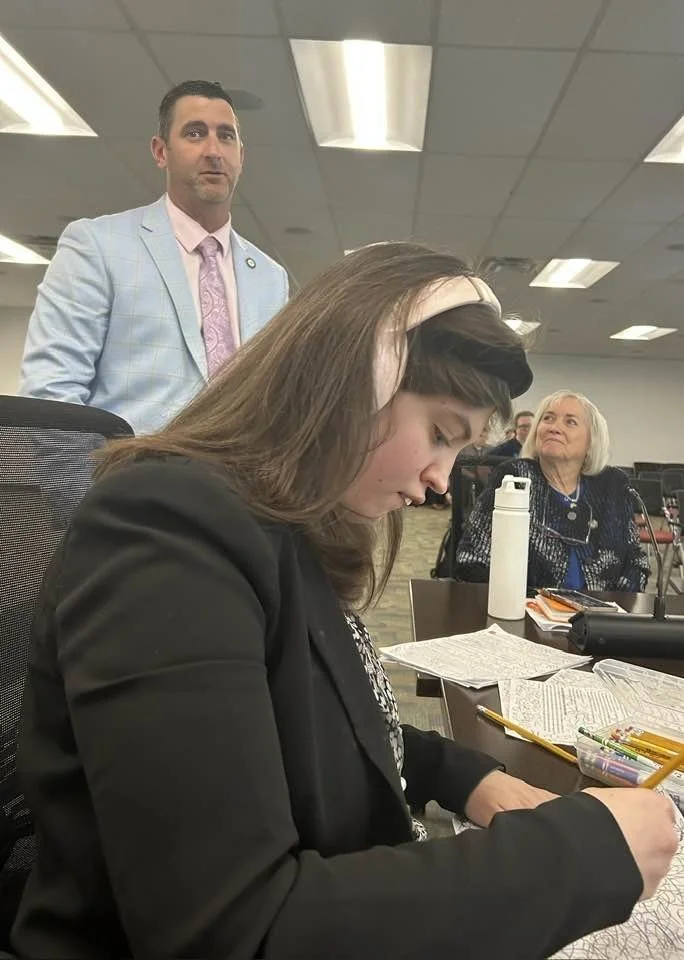
My daughter beside me at our recent Statewide Planning and Policy Council meeting in front of fellow council members TN Representative Clay Doggett (TN-70) and TN Senator Becky Massey (TN-06), two extraordinary champions for disability in the Tennessee General Assembly.
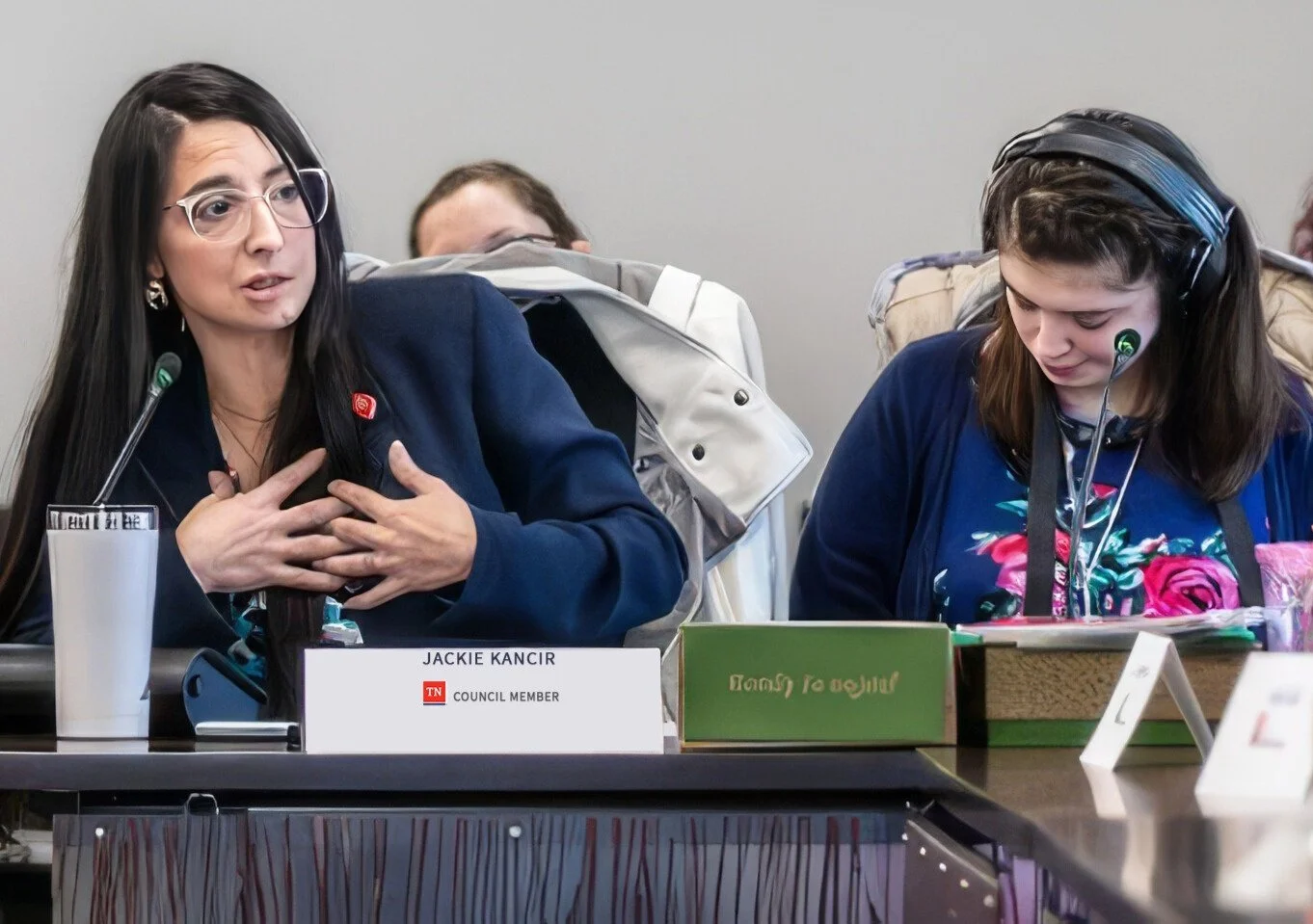
Credit: Jen Vogus, Able Voices
Despite these challenges, the experience has also been hopeful. My fellow council members have been extraordinarily kind and patient through my daughter’s intermittent disruptions. She lights up when we enter the room, and I can tell she is genuinely excited to be part of these gatherings. Her presence has not only been accepted, it has shifted the tone of the conversations. Since she began attending, I have noticed more discussion about the urgent need to address the crisis in care for those with high-acuity, complex medical and behavioral challenges. Her seat at the table makes visible a reality that can no longer be ignored. The willingness of the council to set this example brings me enormous pride in my state.
My heart will continue to stir with unrest, however, until this is the norm, not the exception, in every state in our nation. The individuals requiring the highest levels of support must have visible representation at every table where decisions are being made about their services and programs. This requires a serious and intentional redesign of accommodations that meet the needs of families like mine to participate in policymaking.
The Quiet Discrimination Within Disability Rights
The tragedy here is not just neglect. It is exclusion disguised as progress. When agencies elevate only those who can meet benchmarks of independence and productivity, they reinforce a two-tiered system:
Those who can achieve visible “success” are celebrated and funded.
Those who cannot are quietly abandoned.
This is not what the authors of the DD Act intended. The Act was supposed to protect and support all people with developmental disabilities, not just those most able to approximate typical lives.
A Call to Reframe the Values
It is time to re-examine the criteria guiding DD Act programs. Instead of demanding independence, productivity, and self-advocacy as preconditions for support, we should embrace values that are inclusive of all people with developmental disabilities, including those with the most profound needs:
Safety and Protection — No one should suffer abuse or neglect simply because they cannot speak for themselves.
Dignity and Wellbeing — Quality of life is not measured in paychecks or independence but in health, stability, and human connection.
Family Partnership — For those who require lifelong supervision, families must be recognized as essential partners, not obstacles to “self-determination.”
Lifelong Support — Services must acknowledge that some disabilities are lifelong and intensive, and systems must be designed accordingly.
Access Without Barriers — Participation in policymaking and training must be structured to include caregivers and individuals who cannot leave home or whose child requires constant care and supervision.
Conclusion: Inclusion Must Mean Everyone
The DD Act was a groundbreaking law, yet its guiding principles now risk excluding the very people most in need of its protection. Independence and productivity are worthy goals, however safety, dignity, and survival must come first for those with the most debilitating disabilities.
If our federal programs cannot stretch to include those who will never be independent, then we must admit that “inclusion” has become just another form of discrimination. For families like mine, and for thousands of others across this country, that exclusion is not theoretical. It is lived, painful, and urgent.