The Problem with Autism Barbie (accessories sold separately, services not included)
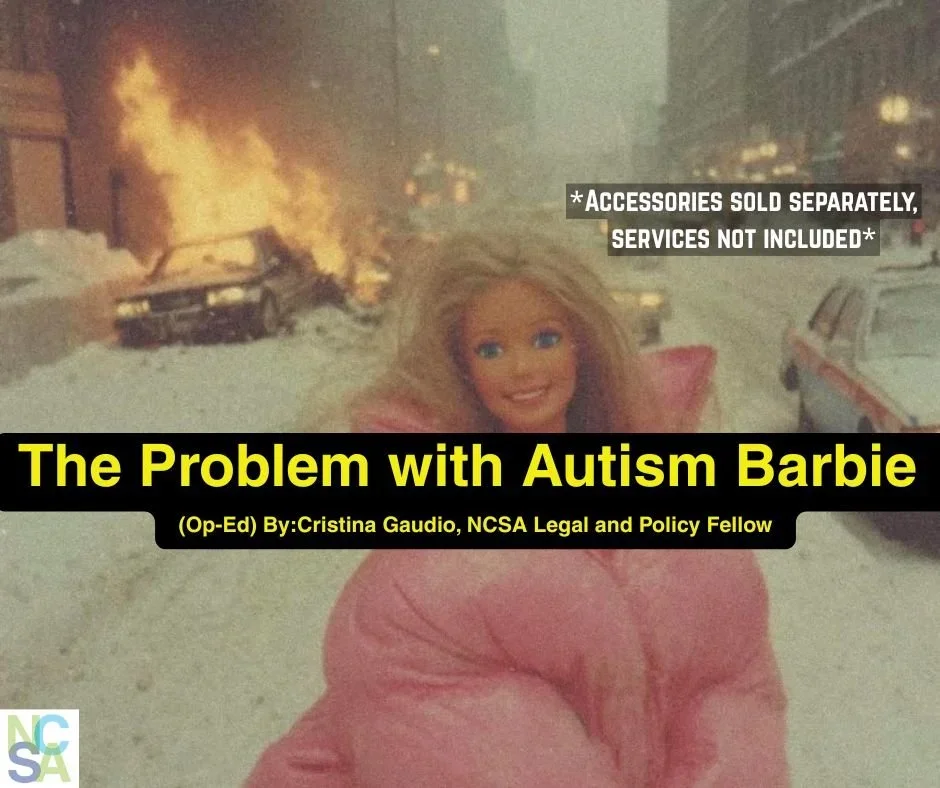
(Op-Ed) By: Cristina Gaudio, NCSA Legal and Policy Fellow
Mattel has released a Barbie with autism. Celebrated as a joyful and "authentic" milestone for autism representation, she is a well-intentioned move toward inclusion. Her existence may teach children not to be scared of their classmates with autism, to recognize their uniqueness, include them, and be kind to them. This is of course a good thing. But like all things Barbie, this new doll exists in fantasy land, where everything, even disability, is just an aesthetic. Cute on a shelf but useless in a crisis, her plastic, one-dimensional face therefore exposes a problem: neurodiversity branding, which centers the celebration of the image of autism, trivializes the needs and experiences of the most severely affected.
Representation is valuable. But no one doll can represent a spectrum, and when one carefully curated image serves as a stand in for an array of wildly different lived experiences, public perception is distorted. Cultural narratives drive policy priorities, and by ignoring the vastness of the spectrum and pushing a message of blanket positivity, the mainstream inclusion machine undermines the urgent fight for meaningful solutions. There are autistic people who are functional, independent, and communicative enough to appreciate seeing themselves in a doll. There are neurotypical people for whom a doll will encourage acceptance, awareness and validation. And then there are autistic people who are non-speaking, severely intellectually disabled, and dependent on others for life. They cannot see themselves in a doll, and require more than representation and celebration to reap real benefit.
The creation of the autistic Barbie jumps over the needs of this latter population and repackages autism into a lifestyle identity. Designed in collaboration with autism self-advocates with zero input from the caregivers of the profoundly affected population, she wears noise-reducing headphones and sensory friendly clothes, and totes a fidget spinner along with an Augmentative and Alternative Communication (AAC) device. To be fair, Mattel didn’t completely represent autism as a feel-good superpower; the design nods to sensory and communication realities, many of which are faced by the more severely affected end of the spectrum. Nevertheless, the problem isn’t the doll’s details; it’s the cultural narrative this product is positioned to represent. Her presentation invites the public to frame autism as a difference rather than a potential disability, where challenges with communication and daily living can be alleviated with modified clothing and technology. And because this is the farthest thing from the truth, she plants yet another seed of autism-positivity misinformation into the minds of the public at a time when actual services are lacking more than ever.
Mattel’s imaging pushes aside the needs of the severely affected population in favor of an image that feeds today’s cultural obsession with marketable inclusion and virtue signaling. The average person will see this doll and blindly celebrate autism, thinking they have received the full, or most, of the picture. They will carry forward a belief that autism is no more than a different way of being, that all the autistic population needs is more media representation, better clothing, and newer devices. Because it feels kind. It feels inclusive. It feels correct. But symbolism is not support, and this takeaway is dangerously misleading. For all of the dollars spent researching, designing, and producing autism Barbie, many children could have received ABA therapy. A residential center could have been built and staffed with professionals to care for severely autistic adults. The highest need population, still waiting for these tangible solutions, has instead received a plastic toy. See why it feels icky?
The caretakers of the most severely affected autistic individuals, of those who objectively have the highest level of need, thus cannot sit comfortably with this imagery. Because even a hundred dolls could not touch on what they require most. And that is 24/7 residential support, access to appropriate therapeutic and medical interventions, and affordable long-term care after parents and caregivers age and die. It is well-trained direct support staff, programs to fill Medicaid waivers, and crisis training for self-injurious behaviors. It is diapers, helmets, and padding on floors. It is causation research. Maybe Mattel will do better with Ken, but whether they do or don’t, it's time to stop celebrating images and start addressing realities. The issue, quite simply, is that the doll gets more attention than the crisis.