Kramer Davis is Tennessee’s only clinic for adolescents and adults with severe autism and IDD. If it closes, families across 52 counties will have nowhere to turn (again). Together, we must act.
Read moreWhen "Inclusion" Leaves the Most Disabled Behind
If our federal programs cannot stretch to include those who will never be independent, then we must admit that “inclusion” has become just another form of discrimination. For families like mine, and for thousands of others across this country, that exclusion is not theoretical. It is lived, painful, and urgent.
Read moreADA at 35 (1990-2025): Recommitting to Equity for People with Severe Autism
Most policies are born through good faith, but without direct experience informing those policies, people with severe autism are suffering the negative impacts of unintended consequences. It is long past time to challenge the tired false binaries that dominate our disability discourse: community vs. institution, autonomy vs. guardianship, employment vs. dependency. These are not helpful when they erase nuance and deny the reality that many need 24/7 specialized support, meaningful daily activity, integrated multidisciplinary healthcare, and purpose-built safe housing options.
We must update our definitions of inclusion to account for choice, dignity, safety, and realism.
Read moreWhen “Public Safety” Policy Affects People with Severe Autism: What Families Need to Know
By Jackie Kancir, NCSA Executive Director
____________________________________
On July 24, the White House released an Executive Order titled “Ending Crime and Disorder on America’s Streets.” While its focus is on homelessness, mental illness, and public safety, many of the proposed actions could have serious — and (hopefully) unintended — consequences for individuals with severe autism and their families.
While acknowledging risk, there may also be potential for improvements in systems of support for our loved ones, too. If implemented wisely and with the right safeguards, this Executive Order (EO) could also offer a unique opportunity to fix what’s long been broken.
What the EO Says — and Why It Matters to Us
The EO calls for:
Expanded civil commitment laws for individuals who “cannot care for themselves” or “pose a danger to others”
A shift away from Housing First models in favor of treatment-linked housing
New federal grants to encourage states to enforce vagrancy laws and move people off the streets
A review of HUD and HHS regulations to align them with “treatment-focused” approaches
That language might seem far removed from the lives of families caring for individuals with severe autism, intellectual disability, and severe behavior, but here’s the reality:
Many of our loved ones can’t access group homes because of aggressive behavior, or when they do, they suffer traumatic abuse.
HCBS waivers are often approved but unstaffed
Emergency rooms have become holding cells when families are in crisis
Police are sometimes the only available responders, and that’s dangerous
This Executive Order, for all its flaws, finally admits something NCSA has long said: that for some individuals, 24/7 structured care is medically necessary, and we have no system to provide it.
Concerns
Here’s the risk: if these new powers are implemented broadly, without disability-specific safeguards, individuals with severe autism could be swept into punitive systems.
For example:
A nonverbal adult pacing, screaming, or bolting in public could be perceived as “dangerous”
A person exhibiting self-injury might be civilly committed under a psychiatric standard that doesn’t fit
Guardians could lose legal decision-making power under vague definitions of “risk”
Programs that center on law enforcement rather than care could criminalize behaviors rooted in neurological disability
We have to be clear: severe autism is not a crime. The aggressive or self-injurious behaviors some individuals exhibit are not acts of intent. There is no “mens rea” (no desire to harm). These are symptoms of pain, distress, and unmet need.
With proper supports — medical care, behavioral therapy, environmental adaptations — many can live safely and meaningfully in a variety of settings that meet their preferences, but they are currently being left behind.
Potential Opening for Dialogue on Improved Systems
If we move quickly and effectively, this EO can be leveraged to:
Advocate for Medicaid-funded residential models that match the complexity of severe autism
Push CMS to revise the HCBS Settings Rule, which states use to block person-centered, autism-specific housing
Establish disability-competent pathways for civil commitment that are therapeutic, not carceral
Build capacity for purpose-built housing models that incorporate clinical and behavioral support
Demand independent oversight and legal protections for those affected by any new policies
This isn’t about nostalgia for institutions. It’s about the right to build something better and the opportunity to do it now.
What Families Can Do
Read my analysis: Click here to view my breakdown of the EO.
Read our Hill Briefing: Click here to view our message to Congress. Share this with your legislators!
Share your story with elected officials. Tell them how the system has failed your loved one, but also tell them what would work for your loved one instead. Be a source of support for your legislators in developing meaningful solutions.
Watch for action alerts from NCSA in the coming weeks. We’ll be submitting comments and proposals to key federal agencies.
Talk to local journalists. Help shift the narrative from “dangerous” to “unsupported.” Send letters to the editors of your local papers.
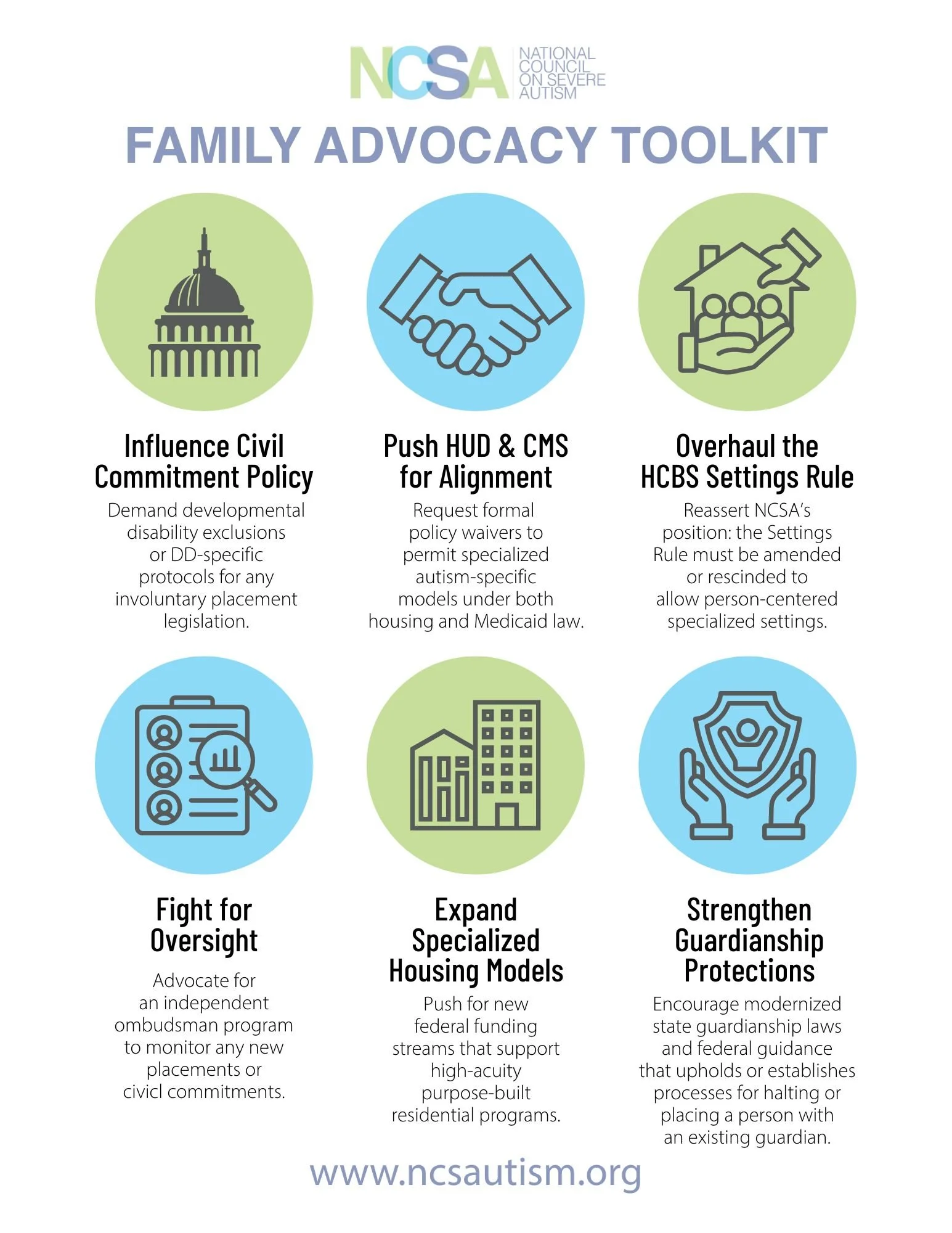
Strengthen Guardianship Protections.
Encourage state legislation to modernize guardianship systems, ensuring both the empowerment of dedicated family guardians and robust accountability mechanisms to prevent misuse or neglect.
Advocate for federal guidance that prevents emergency holds or civil commitments from overriding existing guardianship without due process.
You can download our Family Advocacy Toolkit to keep in front of you when speaking to legislators to help remember the key talking points. Share it on your social networks and help spread the word of how we can build a better future for our children. Find more policy document downloads here.
Final Word
This Executive Order wasn’t written for our children, but it may finally give us a seat at the table. With coordinated, level-headed, well-informed, collaborative advocacy, we can ensure that “public safety” doesn’t become an excuse for surveillance, confinement, or neglect. It becomes an invitation to build real care.
Let’s use this moment to redefine what safe, appropriate, and person-centered really means.
Preventable Tragedies, Systemic Barriers: Severe Autism and the Health Disparity Crisis in Tennessee
As Tennessee’s Chattanooga neglect case sparks debate, families of people with severe autism highlight a deeper crisis: denied safety equipment, untrained staff, punitive policies, and systemic failures that create dangerous, nationwide disparities in care and disability rights.
Read moreHolding Group Homes Accountable: Legal and Policy Failures Exposed — And How the New Jersey Chapter of NCSA Is Leading the Fight
A newly released report from the New Jersey Ombudsman exposes systemic failures in group home oversight, including concealed abuse, unreported critical incidents, underpaid and understaffed care, and investigations that let providers police themselves. These aren’t isolated lapses but signs of a broken system that leaves families in crisis. The New Jersey Chapter of NCSA is responding with strong advocacy—documenting family experiences, demanding transparency, partnering with legislators and journalists, and pushing for meaningful reforms to protect individuals with severe autism.
Read moreWhat the Latest Version of the House Medicaid Reform Plan Means for Families Affected by Severe Autism

Sunday night, House Republicans dropped their latest plan for Medicaid reform, and it’s got a lot of people asking: Should we be worried? Should we panic? And what should we be doing? Here’s what you need to know—without the spin.
Read moreFish, Chickens, and the Folly of Sameness

My daughter shares about as much in common with a Mensa-level PhD candidate as a fish does with a chicken. Nobody’s handing chickens supreme authority to make decisions for fish just because chickens can bawk while fish cannot.
Society never claims that if only fish grew up in chicken-designed “animal-affirming” environments, they’d suddenly take up roosting and learn to crow at sunrise. There’s no assumption that every fish thrives in the same tank conditions, either. Some need fresh water. Others need salt. Certain fish want solitude, others survive best in schools. The important point: experts don’t consult chickens when they want to understand fish. They study the fish themselves. Wild concept, right?
Read moreThe Productivity Trap: How Well-Meaning Disability Advocacy Can Reinforce Eugenic Logic

The fundamental flaw in this approach is not that we celebrate independence—it's that we've allowed independence to become a prerequisite for human dignity. The true antidote to eugenic thinking isn't proving that disabled people can be productive; it's rejecting productivity as a measure of human value altogether.
Read moreOfficial Statement from the National Council on Severe Autism (NCSA)
NCSA maintains that:
Severe autism requires special attention and services distinct from other forms of autism
We face an urgent need for innovation in treatment and support across the lifespan
Research into environmental contributors and other potential causes must be pursued through rigorous scientific channels
Policy reforms must address the complex realities of continuous care requirements
Families and caregivers need expanded access to housing, healthcare, and support services